Azores Hiking Week: São Jorge, Flores and Pico in 7 Days
A Week Built Around Trails, Not Towns
This is not a gentle introduction to the Azores. It is seven days for hikers who have already decided that trails come first and sightseeing second, moving through three islands from three different island groups: São Jorge in the central group, Flores out west, and Pico back in the centre. Each island brings a completely different kind of walking — the coastal fajã shelves of São Jorge, the waterfall-and-crater-lake plateau of Flores around Fajã Grande, and the single, quota-limited ascent of Montanha do Pico, the highest point in Portugal at 2,351 m.
The route is deliberately front-loaded with logistics risk. São Jorge, Flores and Pico are not connected to each other by a reliable, year-round ferry network — that fast, frequent link only exists within the central “Triangle” of Pico, Faial and São Jorge, and even that does not extend out to Flores. Getting between these three islands in a single week means flying with SATA Air Açores, often via a connection through Ponta Delgada rather than a direct hop.
Missing one of those connections does not cost you a day; it can cost the rest of the week, so every flight in this itinerary should be booked well ahead, with a spare buffer day built in rather than assumed away. For the mechanics of that network, see inter-island flights with SATA Air Açores; for the ferry-based alternative that links the central islands only, see inter-island ferries in the Azores.
Car rental is worth arranging on each island separately rather than assuming one booking carries across — there is no single archipelago-wide rental network, a detail covered in car rental in the Azores. For readers weighing whether this concentrated, physical week suits them better than a broader loop, best hikes in the Azores sets out the wider trail landscape this itinerary deliberately narrows down from, and how trail difficulty is graded is worth reading before day one.
Day 1: Arrive on São Jorge
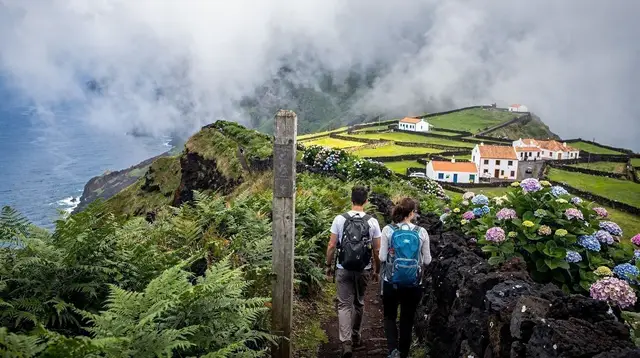
Fly into São Jorge, typically via a connection through Ponta Delgada, and settle in Velas, the island’s main town. Treat this as an arrival day rather than the start of serious hiking — flights can run late, and a tired first push onto exposed cliff trails is how minor injuries happen. A short, flat orientation walk near Velas or along the coast toward Calheta is enough to get a feel for São Jorge’s long, narrow profile: a spine of high pasture dropping in sheer cliffs to the sea, broken by the flat coastal shelves called fajãs. Spend the evening checking gear and confirming tomorrow’s trailhead transport.
Day 2: The São Jorge PR1 Traverse
This is the island’s signature hike and the first physical test of the week: a long, full-day traverse across several of São Jorge’s fajãs, the flat lava-and-landslide platforms that sit at the base of the island’s cliffs, reachable only on foot or by boat. The trail alternates steep descents and climbs between the plateau and the fajãs themselves, with limited shade and no facilities along most of the route.
a guided full-day traverse of the PR1 route across São Jorge’s fajãs takes care of trailhead logistics and route-finding on a hike that runs 9 to 12 hours depending on conditions and group pace — worth booking rather than improvising given the isolation of the terrain. Expect to pass or hear about the island’s cured, appellation-protected cheese along the way; it is one of the few reminders that people actually farm this landscape. For the island’s other trail options beyond this single traverse, see São Jorge’s fajã hikes in detail.
Day 3: A Shorter Trail, Then Fly to Flores
Keep the morning light: a shorter loop near Velas or Calheta rather than another full-day push, since the afternoon is given over to flying to Flores — again typically routed through Ponta Delgada. This is the itinerary’s biggest single point of failure. Flores sits in the archipelago’s western group, whose connections are the most weather-sensitive in the Azores, so build slack around this transfer rather than scheduling anything demanding for the evening you land. Base yourself in Santa Cruz das Flores or push straight on to the western side of the island near Fajã Grande if the light allows.
Day 4: Fajã Grande, Waterfalls and Crater Lakes
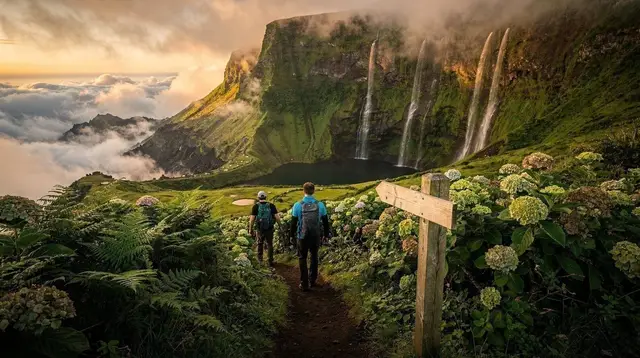
Flores earns its reputation as the Azores’ island of waterfalls and lakes, and this day is built around that landscape. From Fajã Grande, trails lead past cascading waterfalls dropping straight to the Atlantic and up onto the high plateau toward the crater lakes of Lagoa Funda and Lagoa Comprida — the kind of scenery that put the island on UNESCO’s biosphere reserve list. Weather on this exposed plateau changes fast, in keeping with the Azorean habit of running through several seasons in a single afternoon, so carry a proper shell even if the morning starts clear.
a full day exploring Flores with a local guide is a useful way to cover ground efficiently on an island where trailheads are spread out and public transport is limited. For a deeper look at Flores’ individual trails beyond this single day, see Flores hiking trails.
Day 5: High Plateau, Hiking and Swimming
A second full day on Flores, pairing more demanding walking with the chance to cool off in one of the island’s natural pools — a welcome contrast after two consecutive hiking days.
a guided day combining high-plateau hiking with swimming stops is built specifically around that mix, and makes sense as a lower-intensity counterpart to the flat-out trail days on either side of it. Use the evening to reconfirm the next day’s flight to Pico and to repack for a very different kind of hiking day ahead.
Day 6: Transfer to Pico and Preparation
Fly from Flores to Pico, once more likely via Ponta Delgada, and land with one job left to do before dinner: register in person at the Casa da Montanha in Madalena for tomorrow’s ascent of Montanha do Pico. Registration is compulsory, capacity is limited per day, and each climber is issued a GPS locator that must be returned at the end of the walk — arriving a day ahead, rather than trying to register and climb on the same morning, is what makes this itinerary’s tight schedule workable at all.
a guided day getting to know Pico Island before the climb is a good lower-key way to spend the rest of the afternoon — a look at the UNESCO-listed vineyard landscape of stone-walled currais near Criação Velha, or the old whaling port of Lajes do Pico, without spending the legs you will need at dawn.
Day 7: The Ascent of Montanha do Pico
The physical centrepiece of the week. Climbers typically start before or at first light for the steep, loose-rock ascent to the crater rim, continuing on to the Piquinho, the final summit point, where conditions are frequently windy and fogged in even when Madalena below is clear. The published fee structure runs in stages — a lower rate for reaching the Furna shelter, more for the crater rim, an additional charge for the push to the Piquinho, and a further amount for an overnight stay in the crater — plus a returnable deposit tied to the GPS unit; residents of the Azores autonomous region climb for free. Treat these as the framework rather than a fixed, unchanging price, and confirm current figures with the Casa da Montanha before you go.
A certified guide is strongly recommended, particularly for the final stretch to the Piquinho, and cattle grazing near lower access roads are a real hazard worth watching for on the drive up, not a cliché. Descend in the afternoon with enough daylight margin to return the GPS unit at the Casa da Montanha before it closes. For readers considering stretching this into an overnight crater stay instead of a single push, see climbing Mount Pico and overnight camping on Mount Pico before booking flights home, since either option changes the timing of your final day.
Trail Comparison
| Day | Hike | Typical duration | Terrain | Guide recommended |
|---|---|---|---|---|
| 2 | São Jorge PR1 (fajã traverse) | 9–12 hours | Steep descents/climbs, coastal fajãs | Strongly |
| 4–5 | Flores plateau and Fajã Grande | 4–7 hours per day | High plateau, waterfalls, natural pools | Optional, useful |
| 7 | Montanha do Pico ascent | 7–9 hours round trip | Loose volcanic rock, exposed summit | Strongly |
Inter-Island Transfers at a Glance
| Leg | Typical mode | Reliability notes |
|---|---|---|
| São Jorge → Flores | Flight, often via Ponta Delgada | Western group flights are the most weather-sensitive in the archipelago |
| Flores → Pico | Flight, often via Ponta Delgada | Book early; treat the connecting day as non-negotiable buffer, not a hiking day |
| Pico ↔ Faial (not used here) | Ferry, year-round | The one genuinely reliable inter-island link, for comparison |
Planning Notes for a Physically Demanding Week
Budget for this trip sits in the mid-range once guided hikes, inter-island flights and rental cars on each island are added up — none of the three islands is expensive on its own, but flying between three of them three times in a week adds up faster than a single-island stay. A rental car is close to essential on each island for reaching trailheads that public transport does not serve. None of these three islands appears in this itinerary as a base for whale watching, but a short boat trip from Lajes do Pico is an easy add-on if the Pico buffer day allows it.
If this specific combination feels too tightly wound around flight risk, a calmer alternative is to hike within the reliable central Triangle instead — see Pico and Faial in 5 days or São Jorge in 3 days as lower-risk building blocks, and how many days you actually need in the Azores for weighing a slower version of this same route.
FAQ: Planning the São Jorge–Flores–Pico Hiking Week
Is this itinerary a good choice for a first trip to the Azores?
No. It skips São Miguel entirely and assumes you already know you want a week of hard walking rather than a broad first look at the archipelago. First-timers are better served by a São Miguel-based itinerary or an island-hopping trip that mixes sightseeing with shorter trails.
How fit do I need to be to climb Montanha do Pico?
Fit enough for a full day of steep, loose volcanic terrain at altitude, ideally with some prior mountain hiking experience. The climb to the crater rim and on to the Piquinho summit is strenuous, exposed to wind and sudden fog, and closely regulated by the Casa da Montanha.
Do I need to book the São Jorge, Flores and Pico flights in advance?
Yes, and well in advance. This route depends on SATA Air Açores flights that often connect through Ponta Delgada rather than flying island to island directly, so booking early and building in a spare day protects the whole week from a single delay.
What happens if an inter-island flight is cancelled by fog or wind?
Flights can be delayed or cancelled with little notice, especially to and from the smaller islands. Treat the final day in each location as flexible where possible, keep accommodation cancellable, and avoid booking a same-day onward international flight from Pico or Flores.
Do I need a guide for the São Jorge PR1 trail or the Fajã Grande hikes?
A guide is not legally required on these marked trails, but it is strongly recommended for the full PR1 traverse given its length and the isolated fajãs it crosses, and useful on Flores for reading fast-changing weather on the high plateau.
What should I pack for a week of hiking across three islands?
Waterproof boots, a proper rain shell, layers for sudden temperature drops, and a headlamp for a pre-dawn Pico start. Because Azorean weather can turn from sun to rain and back in the same afternoon, pack as if every day could include both.
Can I fit in whale watching during this hiking week?
Only loosely. Lajes do Pico is the archipelago’s historic whale-watching port, so a short boat trip can slot into the buffer day around the Pico climb, but this itinerary does not build in a dedicated whale-watching day.
Is summer the best season for this itinerary?
Summer gives the longest daylight for the Pico climb and the calmest inter-island flying conditions, but it is not guaranteed dry weather. Spring and early autumn are workable for fit hikers who accept a higher chance of a washed-out trail day.
tours.hiking-trails
Verified deep-linked GetYourGuide tours. Book through these links and we earn a small commission at no cost to you.
GetYourGuide does not provide a product photo for this activity — the image shows the meeting point, photographed by us.