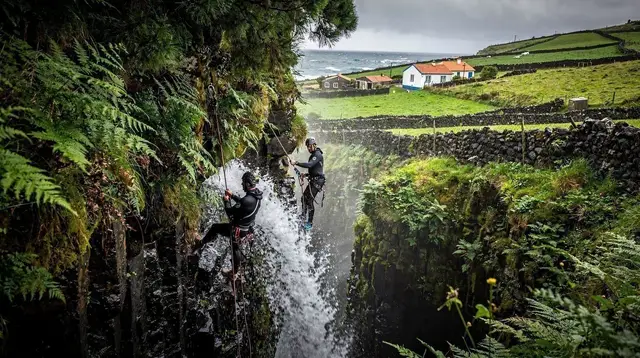
Canyoning in the Azores: A Complete Guide
Can you go canyoning in the Azores without a guide?
No — canyoning in the Azores is always run as a guided activity with an operator, using ropes, harnesses and helmets to rappel down waterfalls in a river canyon. Most tours run as a half-day out of São Miguel, with technical gear provided and no canyoning experience required, though a reasonable fitness level and comfort in water are expected.
Somewhere between a hike and a rope-access job, canyoning is the activity that gets people rappelling down the face of a waterfall, sliding into a plunge pool, and climbing back out soaked and grinning. In the Azores it takes advantage of exactly the terrain the islands are built from: volcanic streams that drop fast off high ground and carve narrow, green-walled canyons on their way to the sea. It isn’t a version of hiking to waterfalls with wet feet — it’s a distinct, gear-heavy, guide-led sport, and understanding that difference before you book is the whole point of this guide.
What Canyoning Actually Involves
Canyoning means moving down a river canyon rather than along it. Instead of walking a marked trail to a viewpoint, you follow the water itself: abseiling down the face of a waterfall on a fixed rope, sliding down smooth rock chutes, jumping from small ledges into pools, and occasionally swimming a short stretch between obstacles. Every one of those moves is set up and supervised by a certified guide, who fixes the ropes, checks harnesses, and calls the order in which the group descends.
The equipment marks it out from anything else on this list of activities. A canyoning outing means a full wetsuit (the water stays cold even when the air is warm), a climbing harness, a helmet, and a guide managing a rope system at every drop — not hiking boots and a daypack. Operators supply all of the technical gear; you show up in a swimsuit and old trainers or water shoes and get kitted out on-site. That equipment list is also the simplest way to tell a canyoning listing apart from a waterfall walk when you’re comparing tours: if it mentions a wetsuit, harness and rappelling, it’s canyoning; if it mentions boots and a trail, it’s a hike.
Where Canyoning Happens in the Azores
Canyoning in the archipelago is concentrated on São Miguel, where the terrain around Ribeira Grande on the island’s north coast has cut some of the best-known descents, including the route at Salto do Cabrito. These are working river canyons rather than tourist viewpoints: narrow, shaded, and only accessible as part of a guided descent, which is a large part of why the experience feels more remote than São Miguel’s more accessible hiking trails.
That concentration on one island is worth being upfront about. Elsewhere in the archipelago, fast-moving volcanic streams and dramatic drops exist too — the fajãs of São Jorge sit at the base of cliffs carved by exactly this kind of water erosion — but bookable canyoning tours, at the time of writing, are a São Miguel activity.
If you’re island-hopping and canyoning is a priority, build it into the São Miguel leg of your trip rather than assuming you’ll find an operator once you reach Terceira, Pico or further west. The Nordeste area, on São Miguel’s less-visited eastern tip, has similarly steep, water-cut terrain, though the established, regularly bookable routes cluster closer to Ribeira Grande.
Why São Miguel’s Volcanic Terrain Makes This Possible
Canyoning exists here because of the same geology that shaped the rest of the archipelago. The Azores sit on the meeting point of three tectonic plates, and every island is a volcanic construction rather than a coral or continental one. On São Miguel, that means streams drop off steep, geologically young slopes over a short distance, cutting narrow gorges through soft volcanic rock rather than meandering across flat ground — exactly the terrain canyoning needs.
The same underlying volcanic system that keeps the crater lake at Sete Cidades full and feeds the Lagoa do Fogo crater higher up the island also carved the canyons the sport uses further downstream. It’s worth knowing this connection if you’re curious about the wider volcanoes and craters that define the islands beyond the sport itself — canyoning is, in a sense, a way of moving through that volcanic landscape rather than only looking at it from a viewpoint.
Canyoning vs Coasteering vs Hiking to Waterfalls
These three activities get confused constantly because they share a setting — water, rock, gear that looks similar in photos — without sharing much else. Here’s the practical difference:
| Activity | What you actually do | Where it happens | Core equipment | Guide required |
|---|---|---|---|---|
| Canyoning | Rappel down waterfalls, slide down rock chutes, jump into pools, descending an inland canyon | Freshwater river canyons, mainly around Ribeira Grande, São Miguel | Wetsuit, helmet, climbing harness, rope | Always |
| Coasteering | Swim, scramble over rocks and jump from the coastline itself | Sea cliffs and rocky shoreline | Wetsuit, helmet, buoyancy aid | Always |
| Hiking to a waterfall | Walk a trail to a viewpoint or the base of a fall, no rope work | Forest and crater trails across most islands | Hiking boots, layers, water | Optional |
If the idea of rappelling appeals but the freshwater canyon setting doesn’t, coasteering is the sea-facing equivalent — same adrenaline register, same gear category, completely different landscape. If ropes and jumps aren’t your thing at all, the islands’ best hikes reach plenty of waterfalls on foot, no harness needed. And for anyone who wants the underwater side of the archipelago rather than the vertical one, diving and snorkelling are separate activities again, done in the open Atlantic rather than a river canyon.
What a Half-Day Canyoning Tour Actually Looks Like
Almost every canyoning tour in the Azores is structured as a half-day outing, and the shape of it is fairly consistent between operators:
- Pickup and briefing — groups are usually small, often gathered from Ponta Delgada or nearby, with an initial safety talk before anyone touches the water.
- Gear fitting — wetsuit, harness, helmet and, on some routes, canyoning-specific footwear, all supplied and checked by the guide.
- Approach — a short walk to the canyon entry point, which is sometimes the only part of the outing that resembles ordinary hiking. this half-day canyoning descent follows that structure across a series of rappels, slides and pool jumps, with the guide setting each rope and going first or last at every obstacle.
- The descent itself — a sequence of drops of varying height, interspersed with swims across still pools; the number and difficulty of obstacles depends on the specific canyon and current water flow.
- Return and debrief — gear comes off at the exit point, and most operators budget time to dry off and change before heading back.
For a route built specifically around one well-known drop, a guided descent of Salto do Cabrito follows the same overall format but is organized around that single canyon system near Ribeira Grande, which is one of São Miguel’s most established canyoning sites.
Who Should Try Canyoning
You don’t need prior canyoning, climbing or abseiling experience — the guide teaches the rappelling technique at the very first drop and controls the rope from above throughout, so the physical skill required is genuinely minimal. What matters more is a reasonable level of general fitness (the approach walk and the climb-outs between obstacles add up), comfort putting your face in water and swimming a short distance in a wetsuit, and a willingness to commit to jumps and drops that can look more intimidating from above than they turn out to be. Vertigo and a strong dislike of cold water are the two things that tend to make canyoning a poor fit, more than age or general athleticism.
Because minimum age and specific fitness expectations vary by operator and by route, it’s worth checking those details directly when booking a canyoning tour in advance rather than assuming a blanket rule applies across the archipelago.
Families traveling with older children sometimes ask whether canyoning is a realistic group activity; the answer depends entirely on each operator’s own age and fitness policy rather than on any archipelago-wide rule, so it’s worth checking before booking rather than assuming either way. For a broader sense of what tends to work well at different ages, the general guide to the Azores with kids and the wider list of family-friendly activities both cover adventure sports alongside the gentler options.
What to Bring — and What’s Provided
Operators supply the technical layer: wetsuit, helmet, harness, rope, and on some routes purpose-made canyoning boots. What you need to bring is simpler:
- A swimsuit to wear underneath the wetsuit
- A towel and a full change of dry clothes for afterward
- Old trainers or water shoes, if the operator doesn’t supply footwear for your route
- Sun protection for before and after the descent, even though most of the canyon itself is shaded
Leave jewelry, watches and anything you don’t want to lose behind — pockets and wrists are not reliable storage on a rope descent. A dry bag for a phone is only worth carrying if your operator explicitly allows it; on many routes cameras and phones stay in the vehicle for the descent itself.
Fitting Canyoning Into a São Miguel Itinerary
Because it’s a half-day activity concentrated near Ribeira Grande, canyoning slots most naturally into a longer São Miguel itinerary that already has a day earmarked for the island’s north coast, rather than being squeezed onto an already-packed final morning. If you’re building your route out from the capital, the general guide to day trips from Ponta Delgada is a useful way to see how a canyoning session can pair with other north-coast stops without doubling back across the island twice in one day.
Booking, Weather, and When to Go
Canyoning tours run as scheduled half-days and fill up in peak months, so booking a few days ahead is sensible rather than optional — see the general notes on booking Azores tours in advance for timing across the archipelago.
Because the whole activity depends on the volume and force of water moving through the canyon, operators watch rainfall closely: after heavy rain, a route can be postponed or swapped for a gentler one for safety, and in the Azores’ changeable climate — where locals joke about four seasons in one day — that’s a real possibility rather than a formality. Build a spare day or two into your itinerary if canyoning is a priority rather than scheduling it for your last morning before a flight.
There’s no single canyoning “season” the way there’s a whale-watching season or a hydrangea season — tours run across most of the year — but warmer months make the surface conditions more comfortable and reduce the odds of a weather-related reschedule. Whatever month you go, pack for the Azores’ habitually damp, quick-changing weather rather than for guaranteed sunshine; the packing list for the islands applies just as much to an adventure-sports day as to a relaxed one.
If you’re weighing canyoning against the coastal alternative, this São Miguel coasteering tour is the clearest side-by-side comparison available to book: same wetsuit-and-helmet gear category, same guided small-group format, but played out along sea cliffs instead of down a river canyon. And if a particular canyon route is sold out or fully booked for your dates, this alternative Salto do Cabrito descent covers the same site through a different operator, which is worth checking before giving up on the date you wanted.
FAQ: Canyoning in the Azores
Is canyoning in the Azores suitable for beginners with no experience?
Yes. Canyoning tours in the Azores are designed for first-timers, with a guide who teaches rappelling technique at the first drop and manages the ropes throughout; no prior canyoning or climbing experience is required.
What’s the difference between canyoning and coasteering in the Azores?
Canyoning descends an inland river canyon by rappelling down waterfalls and sliding into pools, while coasteering moves along the rocky sea coast by swimming, scrambling and cliff-jumping; they use similar gear but happen in completely different terrain.
Which island is best for canyoning in the Azores?
São Miguel is home to the archipelago’s main canyoning routes, including descents near Ribeira Grande such as Salto do Cabrito, and is where the vast majority of bookable canyoning tours operate.
How long does a canyoning tour in the Azores last?
Most canyoning tours are sold as a half-day, typically around four hours including gear fitting, a safety briefing and the descent itself, though exact duration varies by operator and route.
What should I bring on a canyoning tour?
Bring a swimsuit to wear under the wetsuit, a towel and a full change of clothes for afterward; technical gear such as the wetsuit, helmet, harness and rope is provided by the operator.
Is there a minimum age or fitness requirement for canyoning?
Operators generally set their own minimum age and fitness expectations, so it’s worth checking directly when booking; in general, participants should be comfortable in water and able to walk over uneven, wet terrain like that found on São Miguel’s hiking trails.
Can heavy rain cancel a canyoning tour?
Yes. Because canyoning routes follow river water levels, operators can postpone or cancel a tour after heavy rain for safety reasons, which is one more reason to book with some flexibility in your itinerary and to check the category page for canyoning tours for current availability rather than relying on a single fixed date.
Do I need to be a strong swimmer to try canyoning in the Azores?
You don’t need to be a strong swimmer, but you should be comfortable in water: canyoning involves short swims across still pools between obstacles, always in a wetsuit that adds buoyancy, and always within reach of the guide. If you’re not a confident swimmer, say so when booking so the operator can match you to an appropriate route.
Whichever route you end up on, the common thread across every canyoning tour in the Azores is the same: it’s a guided, gear-provided descent through some of São Miguel’s most dramatic — and otherwise inaccessible — volcanic scenery, closer in spirit to the natural swimming pools dotted around the islands than to a conventional hike, but with a rope system and a rappel where the swimming pool would normally end.
Canyoning on GetYourGuide
Verified deep-linked GetYourGuide tours. Book through these links and we earn a small commission at no cost to you.
GetYourGuide does not provide a product photo for this activity — the image shows the meeting point, photographed by us.