What Nobody Tells You About the Azores' Weather
I landed in Ponta Delgada on what the forecast app called a “sunny” day, feeling smug about my timing. Within three hours I’d worn sunglasses, been rained on twice, watched a rainbow arc over the harbor, and put my sunglasses back on. Nobody had warned me that this wasn’t a one-off. It’s just Tuesday in the Azores.
The saying is not an exaggeration
People here have a phrase for it — four seasons in one day — and I used to assume that was the kind of thing every coastal destination says about itself to sound charming. It isn’t an exaggeration in the Azores. It’s closer to an operating manual. The islands sit out in the middle of the Atlantic with nothing to slow down the weather fronts rolling off the ocean, and those fronts move fast. A front can dump rain on you, clear completely, and be replaced by the next one before you’ve finished a coffee.
What surprised me most is how evenly this spreads across the calendar. I want to be direct about this because it’s the mistake I made before I actually lived through a full year here: I assumed the instability was an autumn-and-winter thing, storm season, and that summer would behave. It doesn’t. I’ve had a July afternoon on Faial go from postcard-blue to a proper downpour in the time it took to walk from the marina to a café. The mix of sun and rain shifts with the seasons — more rain hours in winter, more sun hours in summer — but the underlying jumpiness of the sky is there in every single month.
A morning on Pico that taught me to stop trusting the sky
I’ll never forget a hike near Pico that started under a ceiling so grey I nearly turned back. My guide just shrugged and kept walking. An hour later the cloud had lifted enough that the volcano’s summit appeared out of nowhere, and by midday I was applying sunscreen. That morning rewired how I plan a day here. A flat, colorless sky at breakfast tells you almost nothing about what the afternoon holds, and I’ve stopped basing decisions on it. I now check what a local operator or guide is saying about the next few hours rather than what an app promised the night before.
That lesson mattered again on a hike to Lagoa do Fogo, the crater lake up in the hills of São Miguel. The lake sits high enough that it makes its own weather half the time — I’ve arrived to find it wrapped in fog so thick the water was invisible, then watched the cloud peel back within twenty minutes to reveal the whole crater bowl glittering below. If you’d like company and a guide who reads these shifts for a living, a hiking excursion up to Lagoa do Fogo with a small-group hike up to Lagoa do Fogo is a good way to see it without gambling your one shot at the view on a solo attempt timed badly.
The weather doesn’t treat every island the same way
I used to think of “Azores weather” as one thing, and that assumption cost me a soggy afternoon on Terceira that a local could have predicted from the shape of the clouds alone. Terceira sits lower and rounder than São Miguel or Pico, so it doesn’t build the same trapped, moody microclimates — but it still catches Atlantic fronts on its own schedule, out of step with whatever São Miguel is doing that day.
The flatter islands are a different story again. Graciosa and Santa Maria have the least dramatic terrain in the archipelago, and their weather tends to feel steadier through a given day, even when it isn’t necessarily drier over a whole week. Santa Maria in particular sits further south and east than the rest of the group, and that shows up in a climate that runs a touch warmer and drier on average.
Then there are Flores and Corvo, out on their own at the western end of the chain. They catch Atlantic fronts before anyone else does, which is part of why getting to and from them is the most weather-sensitive travel in the whole archipelago — a plan to island-hop out west needs more slack built in than a plan that stays closer to São Miguel or Terceira.
Humidity is the quieter surprise
Rain gets all the attention, but the humidity is the thing that actually changes daily life. Even on days without a drop of rain, the air here holds moisture in a way I wasn’t used to. Towels never quite finish drying on the line. My camera lens fogs up stepping out of an air-conditioned rental car. Trails on São Jorge can still be damp at noon from dew that never fully burned off. None of this is dangerous or even really inconvenient once you expect it — it’s just a texture of being here that nobody mentions until you notice it yourself.
There’s no real dry season to counter it either. The Azores aren’t the Canary Islands or Madeira, and I wince a little whenever I see the islands compared to them as if they share a climate. Those archipelagos get long, confidently sunny stretches. Here, even the driest months — statistically July and August — can still produce a soaked afternoon out of nowhere. I’d rather a visitor arrive expecting that than be disappointed by a single grey day in what they’d been told was the “good” season.
How I actually plan around it now
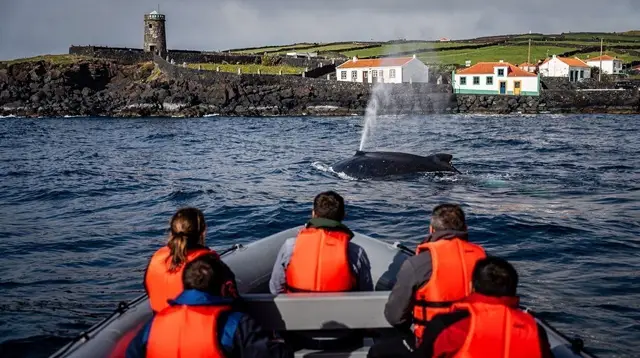
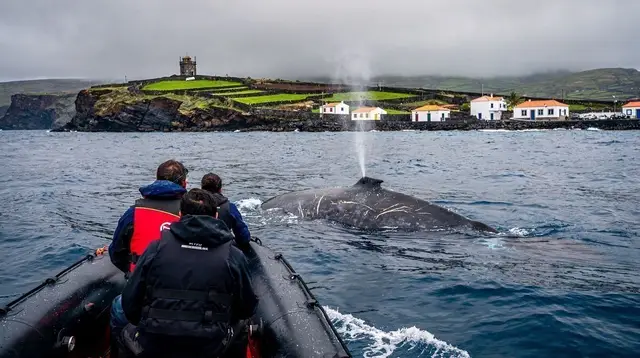
I stopped fighting the unpredictability and started building slack into every day instead. If a boat trip or hike has a flexible window, I take it. On a whale-watching morning off São Miguel, our skipper delayed departure by two hours to let a squall pass, and we still had a calm, clear afternoon on the water — I’d have missed it entirely if I’d cancelled at the first sign of cloud.
That trip, on an Azores whale and dolphin watching outing, is a good example of how operators here work with the weather rather than around a fixed schedule. If whale watching is the whole point of your trip, timing still matters more than people expect, and our guide to the whale watching season in the Azores explains why operators stay this relaxed about short delays in the first place.
I also keep a rainy-day option in my back pocket for every single trip now, not just the ones in November. A covered 4x4 tour of Nordeste is one of my go-to fallbacks — being driven through the greenest, most dramatic corner of São Miguel from inside a vehicle takes the sting out of a downpour, and I’ve booked a full-day 4x4 tour of Nordeste from Ponta Delgada specifically on mornings that looked unpromising, only to end up glad I hadn’t cancelled my whole day.
Walking tours can flex too — a guided stroll through Horta with a local guide walking you through Horta’s marina and streets ducks under cover between showers without losing the thread of the story.
When a whole day turns into a genuine washout rather than just a passing squall, it helps to have a longer list on hand than the fallbacks above — our roundup of rainy day activities in the Azores covers what’s worth doing when the outdoor plan simply isn’t happening.
Packing has changed too. I no longer travel here with a single light jacket and hope. A real waterproof shell, quick-dry layers, and shoes that don’t stay soaked for two days are non-negotiable, whatever month it is and whatever the forecast says the week before I leave. If you want the fuller list of what actually earns a place in a suitcase for these islands, it’s worth reading through before you pack, alongside a rundown of the most common first-timer mistakes people make around weather expectations here. Our full Azores packing list goes into more detail layer by layer, from rain shells down to footwear that actually dries overnight.
What I’d tell a first-time visitor
Don’t pick your Azores trip dates hoping to dodge bad weather entirely, because there isn’t a month that guarantees it. Instead, plan for a climate that keeps you a little off balance in the nicest way — layer your clothing, build flexibility into your itinerary, and treat a rainy morning as a reason to switch plans rather than cancel them. Some of my favorite memories here happened because the weather changed its mind, not despite it. If you want the harder numbers behind all this — rainfall totals, sunshine hours, month-by-month averages — that’s a separate rabbit hole, and a useful one once the general shape of the climate has sunk in.
Our guide to Azores weather month by month lays out those rainfall and sunshine numbers island by season, and pairs well with a look at the best time to visit the Azores if you’re still choosing dates. Getting weather expectations wrong is one of the more common mistakes travelers make in the Azores, right alongside underestimating how long it takes to get from one island to the next. If comparing islands is part of your planning, it’s also worth seeing how São Miguel stacks up against Terceira beyond just the weather.
Once you’re past the initial surprise, the shifting sky stops feeling like an obstacle and starts feeling like part of the show — the way light changes on São Miguel, the way a squall can make a coastline look completely different an hour later. I still check the sky more than the app.
Azores Weather Questions I Get Asked All the Time
Is the changeable weather worse in a particular season?
No, and that’s the part I got wrong before I moved here. The instability is the climate, not a seasonal quirk — I’ve had four-seasons-in-a-day afternoons in July and in January alike. Winter brings more total rain, summer brings more sun hours, but the swings themselves happen year-round.
Does every island have the same weather?
Not at all. São Miguel and Pico both have tall, cloud-snagging terrain that generates its own microclimates, so one valley can be soaked while the coast twenty minutes away is dry. Flatter, lower islands like Graciosa and Santa Maria see fewer of these sudden local pockets.
Should I cancel outdoor plans if it looks cloudy in the morning?
I’ve learned not to. A grey 9 a.m. sky here tells you almost nothing about 1 p.m., and I’ve had some of my best days start under a flat white ceiling that burned off completely by lunch. Local operators watch conditions hour by hour rather than day by day.
What should I actually pack for this kind of weather?
Layers you can add and strip quickly, a proper rain shell rather than a light jacket, and shoes that dry fast. I never leave a guesthouse without a compact waterproof, even on a morning that looks perfectly clear.
Does the weather affect boat trips and hikes at short notice?
Sometimes, yes, especially for the outer islands and anything on open water. Operators reschedule around sea state and visibility more than around rain itself, so a bumpy forecast can move a departure by a few hours rather than cancel it outright.
Is there ever a stretch of reliably dry, sunny days?
Not a guaranteed one. You can get a beautiful run of a week or more, especially in July and August, but I’ve also had washed-out stretches in what was supposed to be the driest month. Treat any dry spell as a bonus, not a promise.
How humid does it actually feel day to day?
Noticeably humid most of the year, even when it isn’t raining. Laundry takes longer to dry, camera lenses fog up walking from an air-conditioned car into the outdoors, and I’ve stopped being surprised by dew still sitting on a trail at midday.
Seasonal experiences on GetYourGuide
Verified deep-linked GetYourGuide tours. Book through these links and we earn a small commission at no cost to you.
GetYourGuide does not provide a product photo for this activity — the image shows the meeting point, photographed by us.