Spa and Wellness in the Azores: An Island-by-Island Overview
Is there a spa and wellness scene across the whole Azores archipelago?
Most of it concentrates on São Miguel, where volcanic heat surfaces as natural hot springs and feeds hotel spa circuits. Other islands offer hotel spas and quieter wellness add-ons like coastal yoga, but not natural thermal bathing on the same scale.
What “wellness” means in a volcanic archipelago
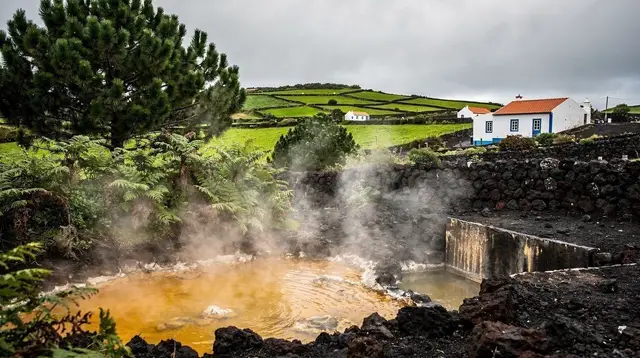
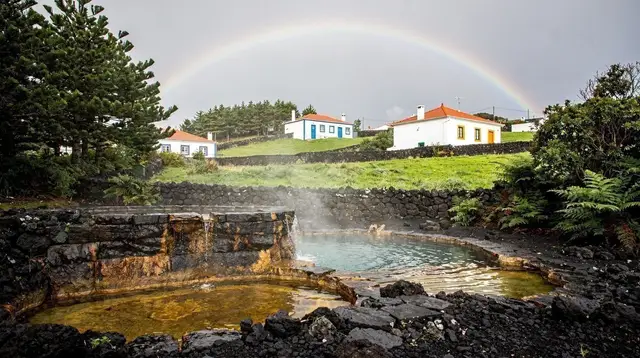
The Azores sit on the meeting point of three tectonic plates, and that geology is the reason wellness travel here looks the way it does. Heat that would otherwise stay locked underground surfaces as steaming pools, warm streams and sulphur-scented ground — and over generations, the islands have turned that raw geothermal activity into places people actually bathe. That is the starting point for any Azores spa itinerary: before you compare hotel amenities, it helps to understand which parts of the wellness picture come from the volcano itself, and which come from a conventional hotel spa built the way you’d find one anywhere else in Europe.
This page is a planning overview, not a site-by-site directory. If you already know you want the details on a specific thermal pool, the dedicated guides go deeper: natural hot springs across the islands, the Parque Terra Nostra thermal pool, the Poça da Dona Beija and Caldeira Velha. Here, the goal is to help you decide how much of your trip to build around wellness, and which island to build it on.
The single most important fact: it is not evenly spread
Visitors often assume that a volcanic archipelago means hot springs on every island. It does not. The Azores’ emblematic thermal sites — the Furnas valley, Terra Nostra, Poça da Dona Beija and Caldeira Velha — are all on São Miguel. Other islands have their own volcanic features (the Furna do Enxofre lava cave on Graciosa, the Algar do Carvão chimney on Terceira), but none of them offer a comparable public thermal-bathing circuit. If a wellness trip focused on natural hot springs is the priority, São Miguel is not one option among several — it is effectively the only one.
That does not mean the rest of the archipelago has nothing to offer a traveller looking to slow down. It means the character of “wellness” changes: away from São Miguel, it tends to mean a hotel spa, a quiet coastal walk, or an activity deliberately paced to feel restorative rather than adrenaline-driven — sunrise yoga on a black-sand shoreline, for instance, rather than a soak in mineral water.
São Miguel: the thermal core of the archipelago
Almost everything a visitor pictures when they imagine “Azores hot springs” happens in and around Furnas, a volcanic valley on the eastern side of São Miguel where the ground itself steams. Three sites anchor the experience, each with a distinct character:
| Site | Character | Setting |
|---|---|---|
| Parque Terra Nostra | Large botanical-garden thermal pool, historic grounds | Furnas village |
| Poça da Dona Beija | Smaller open-air pools, iron-rich water, evening opening hours | Furnas village |
| Caldeira Velha | Waterfall-fed pool at the edge of forest, more compact | Near Lagoa do Fogo |
Because all three sit within a short drive of each other, São Miguel supports something no other island can: a full day built entirely around thermal bathing, without long transfers eating into it. Add the valley’s other draw — the cozido das Furnas, a stew slow-cooked in the same geothermal ground for six to seven hours — and Furnas becomes a natural pairing of food and thermal culture rather than two separate stops.
It’s worth being precise about what these sites are and are not. They are natural or semi-natural pools shaped by decades of public use, not resort spas with treatment menus and booked appointment slots. The Poça da Dona Beija in particular stays open into the evening, which suits visitors who want to end a day of sightseeing with a soak rather than build a whole itinerary around it. One practical note that catches first-timers off guard: the iron content in this water genuinely stains light-coloured swimwear and towels a rust-orange over repeated exposure, so pack accordingly rather than in your best beachwear.
Beyond the valley, Ponta Delgada itself, as São Miguel’s capital and main hotel hub, is where most conventional hotel spas on the island are concentrated — useful for a wellness evening bookended by city amenities rather than a drive out to Furnas.
Hotel spas: the other half of the picture
Distinct from natural hot springs, a straightforward hotel spa — treatment rooms, indoor pools, massage and beauty services — exists on several islands, largely tied to where the archipelago’s larger hotels are based: Ponta Delgada on São Miguel, and to a lesser extent Angra do Heroísmo on Terceira and Horta on Faial. These facilities vary property by property, and some incorporate the region’s volcanic water or mineral clay into specific treatments as a nod to the local geology — but this is not universal, and it’s worth checking with an individual hotel rather than assuming every spa on the islands draws on thermal water.
The practical distinction for trip planning is this: a natural hot spring is a destination in its own right, worth building a half-day around. A hotel spa is usually a complement to a longer stay — something you use in the evening after a day of hiking or driving, not something you travel to a specific part of an island for. If your trip is anchored on an island other than São Miguel, treat hotel spa access as a nice-to-have amenity when choosing where to stay, rather than the reason for the stay itself.
Building wellness into islands beyond São Miguel
On islands without natural thermal bathing, wellness travel in the Azores tends to take a different shape — pacing rather than soaking. Terceira is a good example: alongside its UNESCO-listed old town and volcanic sites like the Algar do Carvão, the island also offers something more explicitly restorative in tone. A sunrise session on the coast, paired with a slow, unhurried breakfast by the ocean, sets a different rhythm than a day of sightseeing — worth considering if part of your trip is meant to be deliberately slow.
a sunrise yoga session and Azorean breakfast by the ocean on Terceira is one of the few bookable activities in the archipelago explicitly built around this kind of pacing, rather than sightseeing or adventure.
Slow, low-intensity outings elsewhere in the archipelago work the same way even when they aren’t marketed as “wellness.” A half-day visit to a working dairy farm, for instance, trades the archipelago’s more physical activities for a quieter, unhurried pace:
a half-day dairy farm visit fits this same slower register, and works well as a counterpoint on a day when you’d rather not hike or dive.
Boat time has a similar effect. Rather than an active whale-watching outing with fast RIB transfers, a calmer sunset cruise leans toward relaxation over wildlife spotting:
a sunset boat tour is worth considering on an evening when the goal is simply to unwind on the water rather than tick off sightings.
And on Flores, at the western edge of the archipelago and, depending on the season, among the last places in Europe to see the sun set, the same slow-travel logic applies to a boat outing built around watching the light change rather than covering distance:
a sunset outing at the westernmost edge of Europe gives the same unhurried pacing a distinctly Flores character.
Deciding how to weight wellness in your itinerary
For most visitors, the honest answer is that wellness in the Azores works best as a component of a broader trip rather than the sole focus of one. A common and effective structure is an active morning — a hike, a boat tour, a drive to a viewpoint — followed by a thermal soak or spa evening, particularly on São Miguel where the logistics make this easy. If you’re planning how many days to spend in the Azores overall, it’s worth deciding early whether São Miguel’s thermal circuit is a priority, since that shapes how much time you allocate to that one island relative to island-hopping elsewhere.
A few planning questions are worth answering before you book anything:
- Is a natural hot spring the priority, or is a hotel spa evening enough? If it’s the former, your itinerary needs meaningful time on São Miguel specifically, not just the Azores generally.
- Are you traveling with a partner, solo, or with family? The pacing and privacy of a hotel spa differs a great deal from an open-air public thermal pool, which matters more for some travellers than others — see our notes on honeymoon planning and solo travel in the archipelago for how this plays out.
- What season are you travelling in? The islands’ changeable weather means an outdoor thermal pool can go from pleasant to genuinely cold and wet within the same afternoon; a rain layer is worth having on hand regardless of season, and it’s worth reading up on the best time to visit the Azores if wellness days are central to your plan.
- Does your budget account for entry fees and treatments? Natural hot springs and hotel spas both carry entry or treatment costs that add up over a trip — factor this into your daily budget rather than treating it as incidental.
A realistic two-to-three day wellness sequence
If wellness is a genuine priority rather than an afterthought, a workable structure looks like this: a first day dedicated to Furnas, moving between the valley’s thermal sites and the cozido lunch; a second day mixing sightseeing on São Miguel with an evening hotel spa session in Ponta Delgada; and, if your trip extends to a second island, a slower day built around one calm, low-intensity outing rather than another thermal soak, since that option effectively disappears once you leave São Miguel. This keeps expectations realistic rather than assuming the rest of the archipelago will replicate what Furnas offers.
Where you stay matters more for a wellness-led trip than for most other Azores itineraries, since proximity to Furnas or to a hotel with its own spa facility saves real time compared with a base further afield — our guide to where to stay in the Azores covers this in more detail, and it’s worth cross-checking against packing essentials so a swimsuit, a towel you don’t mind staining, and a light rain layer all make the list.
Frequently asked questions about spa and wellness in the Azores
Are there hot springs on every island in the Azores?
No. The archipelago’s famous thermal sites — Furnas, Terra Nostra, Poça da Dona Beija and Caldeira Velha — are all on São Miguel. Other islands may have hotel spas or wellness treatments, but not comparable natural hot-spring bathing.
What is the difference between a natural hot spring and a hotel spa in the Azores?
A natural hot spring is geothermal water reaching the surface outdoors, usually iron-rich and often staining, managed as a public or semi-public bathing site. A hotel spa is an indoor wellness facility with treatment rooms, pools and staff, sometimes drawing on volcanic water or mud as an ingredient rather than as the main attraction.
Which island has the strongest wellness offering in the Azores?
São Miguel, by a wide margin, because it combines natural hot springs with the archipelago’s largest concentration of hotels and spa facilities. Terceira and Faial have hotel spas but nothing resembling the Furnas thermal valley.
Do Azores hotel spas use volcanic water or mud in treatments?
Some do, drawing on the region’s mineral-rich thermal water or volcanic clay for specific treatments, but this varies by property and is not a universal feature — check with the individual hotel rather than assuming it.
How many days should I set aside for wellness activities in the Azores?
Half a day covers one thermal pool or spa session comfortably. A dedicated wellness trip built around São Miguel’s hot springs, with a hotel spa evening added in, typically works well over two to three days without feeling rushed.
Can I combine a spa day with other activities like whale watching or yoga?
Yes, and it is a common way to structure a slower-paced day in the Azores — an active morning followed by a thermal soak or spa treatment in the afternoon works well on São Miguel and pairs naturally with wellness-adjacent activities like sunrise yoga on Terceira.
What should I pack for spa and thermal pool visits in the Azores?
A swimsuit and towel you don’t mind staining, since the iron-rich water at sites like Poça da Dona Beija turns light fabric a rust-orange over repeated visits. A light rain layer is worth carrying to and from outdoor pools given the archipelago’s changeable weather.
Spa and wellness on GetYourGuide
Verified deep-linked GetYourGuide tours. Book through these links and we earn a small commission at no cost to you.
GetYourGuide does not provide a product photo for this activity — the image shows the meeting point, photographed by us.