Why São Miguel's Crater Lakes Look Like They Were Painted
Water That Comes in Two Colors
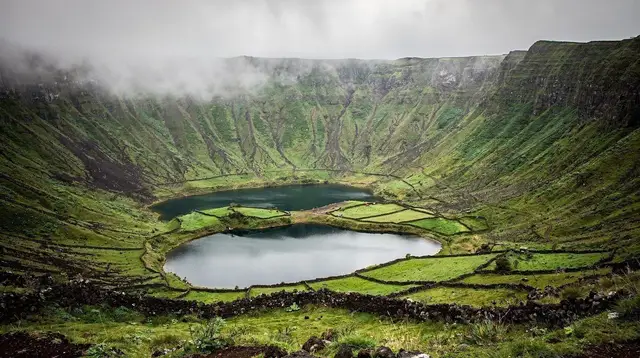
The first time I stood above Sete Cidades and looked down at two lakes sharing the floor of what was obviously one enormous bowl, my instinct was to explain it with something dramatic. Two separate eruptions, maybe, or two different minerals staining the water on either side of some underground wall. The real explanation turned out to be quieter than that, and more interesting once I understood it: I was looking at a single collapsed volcano that had simply been filling with rain for a very long time.
That is the short version of how most of São Miguel’s crater lakes came to exist, and it is worth sitting with before you ever plan a trip around them, because it changes what you are actually looking at when you finally stand at one of those /things-to-do/sete-cidades/ viewpoints.
How a Volcano Becomes a Lake
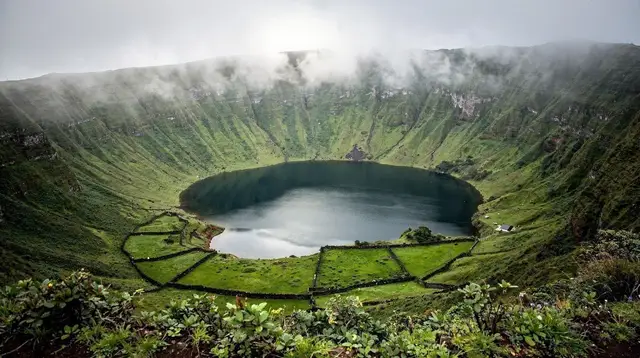
The Azores sit on a seam where three tectonic plates meet, which is part of why the archipelago is so restlessly volcanic in the first place. On São Miguel, some of the island’s major eruptive centers did not simply build a cone and go quiet. After a large enough eruption emptied the magma chamber underneath, the ground above it had nothing left to support it, and it collapsed inward, leaving a wide depression called a caldera. That is a different process from a small crater blown open by a single blast at the surface; a caldera is the aftermath of the whole structure sinking.
Once a caldera forms, geology mostly steps back and lets weather take over. São Miguel gets abundant rainfall and has a naturally high water table, so instead of drying out, the depression slowly fills. Groundwater seeps in, streams collect on the crater floor, and over centuries the result is a lake sitting inside what used to be the volcano’s throat. Sete Cidades formed this way. So did Lagoa do Fogo, in the middle of the island, though it came from a separate eruptive center and is its own independent caldera rather than an extension of the same one. I find that distinction easy to lose track of on a first visit, because from a distance both places produce the same kind of image: a near-perfect green bowl with still water at the bottom.
What I like about understanding the mechanism is that it reframes the view. You are not looking at a lake that happens to sit in a pretty valley. You are looking at the scar of an eruption large enough to swallow its own volcano, now quiet enough to reflect the sky.
The Legend That Explains the Colors, Even Though It Doesn’t
Sete Cidades carries a story that every guide on São Miguel will tell you sooner or later, and I think it is worth knowing before you see the lakes rather than after. A shepherd with green eyes fell in love with a princess who had blue eyes. Her father forbade the match, and when the two lovers were finally separated for good, each is said to have cried a lake into being: one green, one blue, lying side by side in the same crater.
It is obviously a folk tale rather than a geological account, but I do not think that makes it worth skipping. Legends like this one usually exist because the physical detail they are explaining is real enough to demand a story. The two lakes at Sete Cidades genuinely can appear to hold different tones, one leaning toward blue and the other toward a deeper green, depending on the depth of each basin, the algae in the water, and the angle of the light hitting the surface at the moment you happen to be standing above it.
On a bright, clear morning the contrast can be striking. On an overcast afternoon, which the Azores hand out just as often, the two lakes can look nearly identical, and the legend suddenly feels like wishful color grading. I have seen both versions from the same viewpoint on different days, which is part of why the story has stayed alive for so long: it gives people permission to see what the light is willing to show them.
Not Just One Lake, and Not All of the Azores
The other thing I underestimated before spending real time on São Miguel is how many of these basins there are, and how differently each one reads from a viewpoint. Sete Cidades gets the postcard fame, but the island’s crater lakes are not a single attraction, they are a small collection of them, each with its own shape, depth, and mood. Lagoa do Fogo, higher and more exposed to weather, often sits half-veiled in cloud even when the coast below is clear. Smaller, quieter lakes tucked into other calderas around the island rarely make it onto a first-timer’s list at all, simply because they lack a famous legend attached to them.
It is worth being precise about where this phenomenon actually belongs, too. Sete Cidades and Lagoa do Fogo are both features of São Miguel specifically, not a trait shared evenly across the Azores. The archipelago’s nine islands each carry their own volcanic fingerprint, and while collapsed calderas exist elsewhere in different forms, the wide, water-filled lake basins most people picture when they hear “Azores crater lake” are a São Miguel story before they are anything else.
That is also why the island rewards a slower kind of curiosity than a single stop at one overlook. Several of São Miguel’s miradouros frame more than one lake basin in the same sweep of view, so a short hike between viewpoints can turn what looks like one postcard into a sequence of them, each shaped by the same volcanic process but never quite repeating itself.
If seeing more than one of these lakes up close, rather than only from a distant viewpoint, is what draws you here, walking the crater rim is the way people usually do it. A guided hike around the Sete Cidades crater rim threads between several viewpoints in one outing, while a day tour combining Sete Cidades with Lagoa do Fogo covers both of São Miguel’s best-known calderas without requiring you to plan the driving yourself.
For a slower pace with more stops along the way, a full-day tour built around the island’s lake viewpoints tends to suit people who would rather linger at each overlook than move quickly between them.
None of this requires an itinerary decision on your part yet. I wrote this before the practical planning, on purpose, because I think the calderas make more sense once you know what you are actually seeing: not a single scenic lake, but the quiet aftermath of an island that spent a very long time being volcanic before it ever became beautiful.
Questions I Get About São Miguel’s Crater Lakes
Why are there so many lakes inside volcanic craters on São Miguel?
São Miguel is built from a chain of volcanic centers, and several of them collapsed into wide calderas after major eruptions emptied the magma chamber beneath them. Rain and groundwater have been filling those depressions for thousands of years, which is why the island has more than one crater lake rather than a single famous example.
Is the story of the blue lake and the green lake at Sete Cidades true?
The legend of the blue-eyed princess and the green-eyed shepherd is a folk tale, not a geological explanation. The two lakes really do appear to take on different tones depending on light, algae, and depth, which is almost certainly why the story took hold and has been retold for generations.
Are Lagoa Azul and Lagoa Verde at Sete Cidades actually different colors?
From the right viewpoint at the right time of day, yes, they can look distinctly blue and green to the eye, though the effect shifts constantly with cloud cover, sun angle, and the season. On an overcast day the contrast can flatten out almost completely.
Is Lagoa do Fogo part of the same crater system as Sete Cidades?
No. Lagoa do Fogo sits inside its own separate volcanic caldera, roughly in the middle of São Miguel, and formed from a different eruptive center than Sete Cidades. They are two independent examples of the same geological process, not two lakes in one crater.
Are crater lakes found on other Azores islands too?
The classic wide, water-filled caldera lake is most famously represented on São Miguel, but the volcanic collapse process that creates them exists across the archipelago in other forms, from Graciosa’s Furna do Enxofre to Corvo’s Caldeirão. The lake-filled calderas people usually picture, though, are a São Miguel story.
Can I see more than one crater lake from a single viewpoint?
Yes, and that is part of what makes São Miguel’s miradouros so rewarding: several viewpoints frame two or more lake basins in one sweep, rather than isolating a single lake the way postcards often suggest.
Do the crater lakes change color with the seasons?
Their apparent color shifts more with weather and light than with a fixed calendar, though algae blooms and rainfall can subtly deepen or dull the water’s tone at different times of year. There is no single month guaranteed to produce the most vivid colors.
For the practical side of visiting, from trailheads to viewpoint access, the dedicated /guides/sete-cidades-crater-guide/ and /guides/azores-volcanoes-and-craters/ pages pick up where this one leaves off, alongside the /destinations/sete-cidades/ and /destinations/lagoa-do-fogo/ destination guides.
If you are still deciding how to structure a visit, /itineraries/sao-miguel-in-3-days/ and /itineraries/sao-miguel-in-one-day/ both build time around these viewpoints, and /guides/sao-miguel-hiking-trails/ and /guides/best-hikes-in-the-azores/ cover the trails that connect them on foot.
For light and timing, /guides/azores-photography-spots/ and /guides/best-time-to-visit-the-azores/ are worth a look, and /blog/sete-cidades-at-dawn/ captures what the crater looks like before the crowds arrive. For a wider sense of how this island fits into the archipelago, /blog/nine-islands-in-one-sentence-each/ and /destinations/sao-miguel/ are good next stops.
tours.volcanoes-craters
Verified deep-linked GetYourGuide tours. Book through these links and we earn a small commission at no cost to you.
GetYourGuide does not provide a product photo for this activity — the image shows the meeting point, photographed by us.