Terceira's Bull-on-a-Rope Street Festivals Explained
What is a tourada à corda on Terceira?
It is a village street event, unique to Terceira among the nine Azores islands, in which a bull is held by a long rope controlled by a team of handlers and let loose along a barricaded street during summer local festivities. It is not an arena bullfight, the bull is not killed, and spectators who stand too close to the open street can be charged.
A Village Tradition, Not an Arena Show
If you spend a summer week on Terceira and a village street is suddenly barricaded with heavy wooden boards, loudspeakers are playing brass band music, and a crowd is gathering on doorsteps and balconies, you have likely stumbled on a tourada à corda. It is worth understanding before you find yourself standing in the wrong place at the wrong moment.
This is not a bullfight in the Spanish sense, and it is not a tourist spectacle staged inside a fenced arena for a paying audience. A tourada à corda is a village-run event: a bull on a long rope, held and guided by a team of local men, let loose to run down a closed street during a parish festa. It happens only on Terceira. None of the other eight Azores islands hold anything like it, so do not expect to see one on São Miguel, Pico, or anywhere else in the archipelago.
This guide explains what actually happens, why the rope matters, when and where the season runs, and — most importantly for a visitor — how to watch from a genuinely safe position rather than learning the hard way that an open village street is not the same as a grandstand seat.
What a Tourada à Corda Actually Is
The literal translation, “bullfight by rope,” is a fair description of the mechanics. A bull is fitted with a harness, and a thick rope, often 20 to 30 metres long, is attached to it. A team of men called pastores hold the rope and walk or run alongside and behind the animal, using its length and their own weight to slow it, redirect it, or pull it back when it gets too close to the crowd.
The bull is released into a section of street that has been closed to traffic and lined, at intervals, with temporary wooden barricades set into doorways and side openings. There is no fixed ring, no seating, and no admission ticket. The “arena” is simply the village’s own main street for the length of the event, and the audience is the community itself, supplemented in summer by visitors who happen to be in the right village on the right evening.
Several bulls are typically run in succession over the course of an evening, each with its own rope team, and the event can stretch over a few hours as different animals are brought out, run, and returned to their pen.
The Rope, the Handlers, and the Rules
The rope is the entire safety mechanism, and it is worth understanding what it can and cannot do. The pastores can slow the bull, redirect it away from a person who has stumbled into the open, or haul it back before it reaches a barricade at full speed. What the rope cannot do is remove all risk: a bull that lunges suddenly, or a rope that slips or is dropped, can close the gap between animal and spectator far faster than most people expect.
This is the single most important thing to carry away from this page if you plan to watch a tourada à corda as a visitor: the event is built around managed risk, not eliminated risk. The men running the rope teams have grown up around this tradition and understand distances, the bull’s likely reactions, and the layout of their own village street in a way a first-time visitor does not. Their comfort standing close to the action is not a signal that it is equally safe for a bystander unfamiliar with the event.
Where and When It Happens: Terceira’s Summer Calendar
Touradas à corda are tied to the island’s calendar of parish festas — local celebrations organised village by village, many of them connected to the Divino Espírito Santo devotions that run through the Azores’ summer months. Because each parish sets its own festa dates, there is no single fixed “bull running season” with published dates good for every village; the practical season runs broadly from June into September, with most activity concentrated in July and August when festa season is at its busiest across the island.
If a summer visit to Terceira is on your itinerary and seeing a tourada à corda is part of the plan, the reliable approach is to ask locally — at your accommodation, or at the tourism office in Angra do Heroísmo — which villages have an event scheduled during your specific dates, rather than assuming one will simply appear. Runs take place in villages across the island, including in the areas around Angra do Heroísmo and Praia da Vitória, as well as smaller inland and coastal parishes.
This page deliberately does not attempt to lay out the island’s full religious festival calendar — for that broader context, see our guides to Azores religious festivals and the Azores festivals calendar. What follows here is specific to the bull-running tradition itself.
Reading a Village Bull Run as a Visitor
Arriving at a tourada à corda without local context, it can take a few minutes to understand what you are looking at. A few cues help:
- The barricades come first. Heavy wooden boards fixed across doorways, side alleys, and shop entrances along a stretch of street are the clearest sign an event is about to happen. They are there so that anyone caught in the open street has somewhere to duck behind.
- The crowd builds gradually. People gather on balconies, at upper windows, and behind the barricades well before the first bull appears. If you see a village street filling up this way in summer, it’s worth asking a local what’s happening before you park yourself in the middle of it.
- The bull is not always visible from a distance. Because the run moves along the street and the bull is on a rope rather than confined, its exact position can change quickly. Do not assume that because you cannot currently see the animal, the street is safe to walk through.
- This is free to watch, but not organised for tourists. There is no schedule board, no ticket booth, and often no formal barrier separating “spectator zone” from “runner zone” beyond the wooden barricades themselves and community common sense.
Watching Safely: Where to Stand, What to Avoid
The single practical piece of advice this page exists to give is this: watch from behind a barricade, from a doorway with a clear line of retreat, or from an upper balcony or window — never from open ground with no obstacle between you and the street.
| Good vantage point | Why it works | Avoid instead |
|---|---|---|
| Behind a fixed wooden barricade | Physically blocks the bull’s path while you keep a clear view | Standing at the open end of a barricade “for a better angle” |
| A doorway or recessed entrance | Gives you a step back out of the street’s line entirely | Standing flush against a wall with no recess to step into |
| An upper-floor balcony or window | Removes you from street level altogether | Leaning far out over a low balcony rail for photos |
| A side street already closed off from the run | Full separation from the run route | Cutting through a side street to “get ahead” of the bull |
A few further points worth carrying with you:
- Do not assume a break in the crowd means the run has finished. Bulls are brought out one after another over the course of an evening, sometimes with gaps of many minutes in between.
- Keep young children and anyone unsteady on their feet well back from any position where a fast retreat would be needed — a doorway or balcony is a much better choice for them than a spot behind a barricade at street level.
- If you are travelling with a car, do not park along the closed street thinking you’ll simply move it later; roads are shut for the duration of the event and access can be unpredictable.
- Alcohol is often part of festa evenings generally; keep a clear head specifically during the periods when a bull is actually running.
- If in doubt about where it is safe to stand, ask a local resident rather than guessing from the layout — they will know the specific street and its history far better than a general rule can capture.
Is It Cruel? Is It Dangerous? An Honest Look
These are two separate questions, and it is worth answering them separately rather than blending the tradition’s ethics with its physical risk.
On the animal welfare question: unlike a Spanish corrida, the tourada à corda does not involve killing the bull, does not use blades or darts against it, and the animal is walked back to its enclosure once the run ends. That does not mean the event is free of stress or risk to the animal — being run through a crowded street on a rope is not a neutral experience for a bull — but the structure of the event is fundamentally different from arena bullfighting, and it is inaccurate to describe it in the same terms.
On the safety question for spectators: the risk is real, not folklore. A bull that breaks from its expected line, a rope that slips from a handler’s grip, or a spectator who steps into the open street at the wrong moment can result in genuine injury. This is precisely why the “where to stand” guidance above matters more than any other piece of advice on this page. Treat the tourada à corda with the same seriousness you would treat any event involving a large, unpredictable animal and a crowd in an open street — because that is exactly what it is.
Beyond the Bull Run: What Else to Do on Terceira
A tourada à corda is usually one evening within a longer stay on the island, and Terceira has plenty to fill the rest of a summer trip. The island’s UNESCO-listed historic centre in Angra do Heroísmo rewards an unhurried walking visit, and a guided introduction can help place the town’s maritime history in context.
a guided walking tour through Angra do Heroísmo’s historic streets is a useful way to spend a daytime hour before an evening festa.
To see more of the island in a single outing, a half-day tour around Terceira’s countryside and coast covers ground that’s hard to reach without a car, while a full-day tour along Terceira’s north coast or a matching south-coast route works well for visitors staying longer and wanting a fuller loop of the island.
Terceira’s volcanic underside is also worth a visit away from the festa crowds: a guided tour through one of Terceira’s volcanic caves makes a good contrast to a street full of noise and barricades, and pairs naturally with a look at the Algar do Carvão volcanic chimney.
For planning the rest of a Terceira stay, our 3-day Terceira itinerary lays out a workable rhythm of town, coast, and countryside days, and our best time to visit the Azores and Azores in summer guides cover how the festa season fits into the island’s wider weather and crowd patterns.
If you’re driving yourself between villages to catch an evening event, see car rental in the Azores and driving in the Azores for practicalities specific to island roads, and our general Azores travel safety guide for a wider view of risk awareness on the islands. For getting to Terceira in the first place, see getting to the Azores and inter-island flights with SATA.
If you’d rather explore what else the island offers beyond a single evening’s festa, our things to do on Terceira page and our note on Azores crafts and souvenirs round out a longer visit.
Terceira Bull Running: Frequently Asked Questions
What exactly is a tourada à corda?
It is a rope-run bull event held in the streets of a village on Terceira. A bull wears a harness attached to a long, thick rope that several men, called pastores, hold and use to guide and restrain the animal as it runs along a closed-off street lined with temporary barriers.
Is a tourada à corda the same as a Spanish bullfight?
No. A Spanish corrida takes place in a fixed arena in front of seated spectators and ends with the bull’s death. A tourada à corda happens in an open village street, the bull stays on a rope the whole time, and it is walked back to its pen afterwards unharmed by the event itself.
Is the bull hurt or killed during a tourada à corda?
The bull is not killed and is not the target of any weapon. It is restrained by rope and harness throughout. Injuries can occur to the animal or to people if the rope slips or a handler loses control, but the event is not structured around wounding or killing the bull.
When does the bull-running season happen on Terceira?
Touradas à corda cluster in the summer months, roughly June to September, tied to the calendar of local parish festivities, including celebrations linked to the Divino Espírito Santo. Exact dates change from village to village and year to year, so check a specific parish’s festa calendar rather than assuming a fixed date.
Where can I watch a tourada à corda safely as a visitor?
Stand behind the wooden barricades set up along the run, in a doorway with a clear escape route, or on an upper balcony overlooking the street. Never stand in an open side street, an unbarricaded junction, or a spot with no obstacle between you and the bull.
Can tourists take part in the run itself?
Local men, mostly from the village hosting the event, run close to the bull as an established, understood risk within their own community. Visitors are not part of that tradition and have no reason to enter the open street; the appropriate role for a visitor is spectator, from behind a barrier.
Is it dangerous to watch a tourada à corda?
There is real risk to spectators who misjudge the bull’s path, stand in an open space, or step out from behind a barrier at the wrong moment, since the animal is not fully contained the way it would be in a closed arena. Watching from a marked safe position removes most of that risk.
Do any other Azores islands hold bull runs like this?
No. The tourada à corda is specific to Terceira among the nine Azores islands. It does not take place on São Miguel, Pico, Faial, or any of the others, and it should not be expected as part of a general Azores festival calendar.
tours.history-heritage
Verified deep-linked GetYourGuide tours. Book through these links and we earn a small commission at no cost to you.
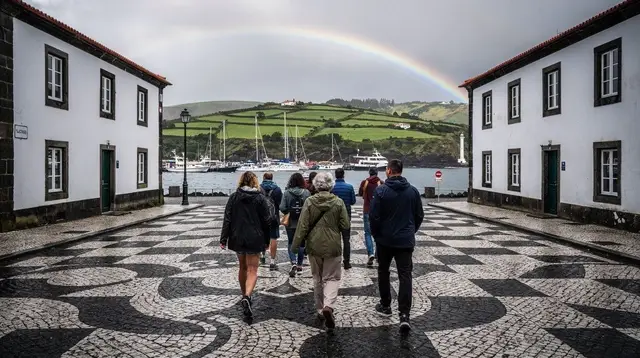
GetYourGuide does not provide a product photo for this activity — the image shows the meeting point, photographed by us.