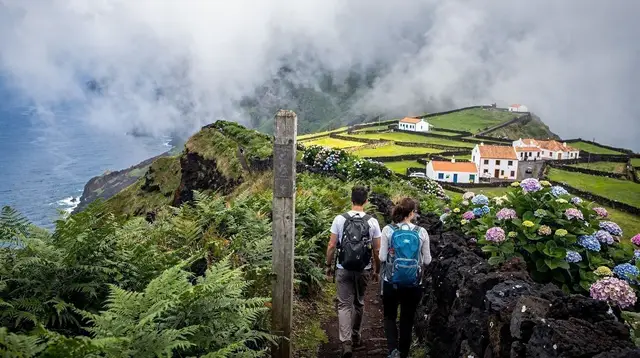
Salto do Prego Hike (Faial da Terra, São Miguel)
How hard is the Salto do Prego hike?
The trail from Faial da Terra to the Salto do Prego waterfall pool is a moderate half-day walk on São Miguel, roughly 7 to 9 km round trip depending on which loop you close it with. There is some uneven, sometimes muddy ground and a handful of short climbs, but no technical scrambling, and most reasonably fit walkers finish comfortably in three to four hours plus swimming time.
A Half-Day Waterfall Walk on São Miguel’s South-East Coast
Salto do Prego is a waterfall with a natural swimming pool at its base, reached by a footpath that starts in the hamlet of Faial da Terra, on the south-east coast of São Miguel, close to Ribeira Quente. The walk follows a stream valley inland, climbing gently through pasture and laurel forest before dropping down to the pool. It is one of the more accessible waterfall hikes on the island: no permits, no quota, no booking desk — just a trailhead, a path, and a cold swim waiting at the end.
This page covers that one hike in detail: how to get to the trailhead, what the path is actually like underfoot, what the pool is like once you get there, and the practical decisions — guided or independent, morning or afternoon, picnic or restaurant — that shape a half-day out. If you are trying to decide which trail on the island to prioritise in the first place, our broader São Miguel hiking trails overview and the archipelago-wide best hikes in the Azores ranking are the better starting points; if you already know you are heading to Faial da Terra, read on.
Quick facts
| Trailhead | Faial da Terra, Povoação municipality |
| Nearest town for supplies | Vila Franca do Campo or Povoação village |
| Distance | Roughly 7–9 km round trip, depending on the loop |
| Walking time | 3–4 hours out-and-back; up to 5 hours with a loop extension |
| Difficulty | Moderate: gentle but sustained gradient, uneven ground, stream crossings |
| Terrain | Farm track, forest path, stepping stones, a short section of steps |
| Highlight | Waterfall pool at Salto do Prego, cold-water swimming |
| Facilities at trailhead | Small car park, café/snack options in the village, no facilities at the pool itself |
Getting to the Faial da Terra trailhead
Faial da Terra sits on São Miguel’s south-east coast, a short drive past Povoação and not far from Ribeira Quente and the Furnas valley. Coming from Ponta Delgada, plan on roughly an hour’s drive along the south coast road, longer if you stop in Nordeste or Furnas on the way. A rental car is by far the easiest way to reach the trailhead: public buses along this stretch of coast are infrequent and not built around hikers’ schedules, so most visitors either self-drive or book a tour that includes transport from Ponta Delgada or the Furnas area.
There is a small car park at the edge of Faial da Terra where the marked trail begins, well signposted from the village’s single main street. Arrive early if you can — not because of any quota, but because the car park is genuinely small and fills up on weekends and in July and August. An early start also means walking the first stretch in cooler air, which matters more than it sounds on a shadeless farm track.
⚠️ One point of confusion worth clearing up before you go: Faial da Terra is not the island of Faial. Faial da Terra is a parish on São Miguel, and it is the trailhead for this hike. Faial is a separate island altogether, in the central group with Pico and São Jorge, reachable only by plane or a multi-hour ferry crossing — nowhere near this trailhead. If a map or a booking listing mentions “Faial,” check which one it means before you plan your day around it.
What the trail is actually like
The path out of Faial da Terra climbs gradually along a stream valley, alternating between open pasture with sea views back toward the coast and shaded stretches under laurel and eucalyptus. The gradient is one of the gentler ones among São Miguel’s waterfall walks, but it is sustained rather than flat, and the ground is often uneven: farm track, packed earth, tree roots, and a few sections of loose stone. After rain, expect mud in the low points and slick footing on any exposed rock.
Roughly halfway along, the path crosses the stream more than once on stepping stones or narrow footbridges, depending on recent rainfall and how the local council has maintained the crossings that season. None of these crossings are difficult in normal water levels, but they are the main reason boots with grip matter more here than trainers: wet stone is the trail’s real hazard, not steep drops or exposure.
As you approach Salto do Prego, the path descends toward the stream bed, and the sound of the waterfall arrives before the view does. The final stretch involves a short, sometimes steep descent to reach the pool itself — take it slowly if the ground is wet, since this last section is where most minor slips happen.
Some hikers extend the walk into a longer loop that also touches Salto do Cabrito and the smaller Sanguinho falls further along the same valley system, turning a there-and-back afternoon into a fuller day. If you want that extended version without navigating the extra junctions yourself, a guide who already knows the route is genuinely useful here:
a guided hiking tour that links Salto do Prego with the Sanguinho falls covers exactly that longer loop with a local leading the way.
For a general sense of how Azorean trails are graded and what “moderate” tends to mean island to island, see our trail grading guide — Salto do Prego sits solidly in the middle of that scale, harder than a paved lakeside path but easier than the exposed crater rims found elsewhere on the island.
The waterfall and the swim
Salto do Prego itself is a single-drop waterfall feeding a rock-lined pool deep enough for swimming, fringed by ferns and overhanging vegetation that keeps at least part of the pool shaded even at midday. This is river water, not a treated pool: it runs cold year-round, clear rather than warm, and the bottom is uneven rock rather than sand, so water shoes make a real difference to how comfortable the swim actually is.
There are no lifeguards, no changing rooms, and no facilities at the pool — pack in what you need and pack out what you bring. A dry bag is worth carrying if you plan to photograph the swim, since there is nowhere to safely leave a phone beyond a flat rock. Depth and current both shift with recent rainfall: after heavy rain the pool can run higher and colder than usual, and it is worth reading the water rather than jumping straight in on a first visit.
For a comparison of Salto do Prego against the island’s other well-known natural pools and where each one sits on the swimmable-versus-scenic spectrum, our natural swimming pools guide is the right companion read. If you would rather have someone else handle the logistics and just show up with a towel, the most straightforward option bundles the hike, the swim, and a picnic into one outing:
a guided Salto do Prego hike with a picnic stop by the waterfall takes care of transport and food so the only decision left is when to get in the water.
Combining the hike with Furnas
Faial da Terra’s position on the south-east coast puts it within easy reach of the Furnas valley, and pairing the two into one day is a common and sensible plan: hike in the cooler morning hours, then drive over to soak in Furnas’ thermal waters or eat cozido in the afternoon once your legs have earned it. This page is not the place for the details of Furnas itself — its thermal pools, its slow-cooked stew, and its gardens are covered properly in our dedicated Furnas guide and cozido das Furnas guide — but it is worth knowing that a combined tour exists for anyone who would rather not plan the transitions themselves:
a combined hike to Salto do Prego and a soak in the Furnas hot springs strings the two together in a single booked day.
When to go
São Miguel’s south-east coast follows the same weather pattern as the rest of the island: expect the “four seasons in one day” that locals describe, with fast-moving Atlantic fronts capable of switching a clear morning into a downpour and back to sunshine within a few hours. Do not plan the whole day around a single morning weather check — bring a rain layer regardless of what the sky looks like at the car park, and treat any forecast as a rough guide rather than a guarantee.
July and August are statistically the driest months and the most reliable for firm footing on the trail, though neither month is rain-proof. If the hedgerows along the way matter to your trip — and this valley does get its share of hydrangeas lining the farm track in season — the flowers are typically at their fullest from July into August, having started opening in May and June and beginning to fade by early autumn; a visit outside that window may only catch the start or the tail of the bloom.
Our hydrangea season guide covers the timing in more detail for anyone planning a trip specifically around the flowers, and the broader best time to visit the Azores guide sets this hike’s weather against the rest of the calendar.
Whatever the season, walking earlier in the day means firmer ground, a quieter car park, and a cooler climb — worth prioritising over a leisurely start.
Guided or independent
The trail to Salto do Prego is popular and reasonably well trodden, which is why many visitors walk it independently without any trouble. Going without a guide works well if you are comfortable navigating from a marked trailhead, are hiking in dry conditions, and are not trying to add the longer Sanguinho or Salto do Cabrito extensions on the fly.
A guided option earns its price back mainly in two situations: if you would rather not drive and navigate the coast road yourself, or if you want the fuller loop without second-guessing which fork in the path to take. Beyond the two combined options already mentioned, hikers looking for something more adrenaline-driven nearby sometimes pair a Faial da Terra morning with an afternoon of canyoning at the neighbouring Salto do Cabrito:
a canyoning trip through the Salto do Cabrito gorge is a wetter, more technical alternative for anyone who wants more than a walk-in swim.
For a gentler point of comparison elsewhere on the island, the crater-lake walk at Lagoa do Fogo is a popular alternative half-day hike with a very different landscape — open crater rim rather than a shaded stream valley — worth weighing against Salto do Prego if you are trying to choose just one for a short trip.
What to bring
- Footwear: closed shoes with real grip — trail runners or light hiking boots — rather than casual sneakers or sandals, given the mud and wet stone.
- Swimwear and water shoes: pack them dry in a bag; the pool’s rocky bottom is uncomfortable barefoot.
- A rain layer: even under a clear morning sky, given how fast weather turns on this coast.
- Water and food: there is nowhere to buy either once you leave Faial da Terra, and a picnic by the pool is one of the better reasons to make the walk in the first place.
- A dry bag or waterproof phone case: if you intend to photograph the swim rather than leave your phone in the car.
- Cash: small cafés in Faial da Terra and nearby villages are not always set up for cards.
Nearby if you have more time
Faial da Terra sits close enough to several other sights that it rarely needs to be a whole day on its own. Vila Franca do Campo and its coastal islet make an easy detour on the drive back toward Ponta Delgada, and Nordeste extends the south-east coast further for anyone with an extra half day. If you are building a longer stay around São Miguel rather than a single outing, our São Miguel in 5 days itinerary slots this hike into a fuller week, and the dedicated Azores hiking week itinerary is built specifically for visitors prioritising trails like this one over beach time.
Salto do Prego Hike FAQ
How long is the Salto do Prego hike?
Most walkers cover the out-and-back route from Faial da Terra to the waterfall and back in three to four hours of walking, not counting time spent swimming or eating. If you extend the loop toward Salto do Cabrito or Sanguinho, budget closer to five hours.
Is the Salto do Prego trail suitable for beginners or families?
It suits fit beginners and families with older children who are used to uneven paths. The gradient is gentle for an Azorean trail, but there are stream crossings, muddy sections after rain, and no railings near the waterfall pool, so it is not a paved, stroller-friendly walk.
Can I swim at Salto do Prego?
Yes, swimming in the natural pool below the waterfall is the main reason most people make the walk. The water is cold, untreated river water, with a rocky and uneven bottom, so wear water shoes and expect a bracing dip rather than a heated thermal pool.
Is Faial da Terra the same as Faial island?
No. Faial da Terra is a small parish on the south-east coast of São Miguel, in the Povoação municipality, and it is the trailhead for this hike. Faial is a separate island in the central group, hours away by air or ferry. The shared name is a coincidence, not a connection.
Do I need a guide, or can I hike Salto do Prego on my own?
The path is well used and marked closely enough that confident independent hikers manage it without a guide, especially in dry conditions. A guided option is worth booking if you want local commentary, help with the drive out to Faial da Terra, or reassurance on the stream crossings after rain.
What should I pack for the hike?
Sturdy shoes with grip, a swimsuit and quick-dry towel, water shoes for the pool, a rain layer even on a sunny morning, water, and snacks or a picnic. A dry bag for your phone and camera is worth it if you plan to swim.
What’s the best time of year to hike to Salto do Prego?
The trail is walkable year-round, but paths are driest and least slippery from June to September. If hydrangeas along the way matter to you, aim for July or August, when the hedges are at their fullest; earlier or later visits may only catch the start or tail end of the bloom.
Can I combine Salto do Prego with Furnas hot springs in one day?
Yes, and it is a popular pairing since Faial da Terra sits a short drive from the Furnas valley. Many people hike in the morning while the air is cooler, then drive to Furnas in the afternoon to soak and eat cozido, or book a tour that already bundles the two.
tours.hiking-trails
Verified deep-linked GetYourGuide tours. Book through these links and we earn a small commission at no cost to you.
GetYourGuide does not provide a product photo for this activity — the image shows the meeting point, photographed by us.