Where I Actually Found the Azores' Hydrangeas
I had read, before I ever landed, that Faial was called the Blue Island because of its hydrangeas. I pictured one spectacular garden, maybe a park, something with a gate and a ticket booth. What I found instead, driving out of Horta toward the Caldeira for the first time, was a hedge. Just a hedge, running along both sides of the road, blue-violet and thick enough that I slowed the car without meaning to. It kept going. And going. By the time I reached the turnoff toward Faial’s western coast near Capelinhos, I had stopped counting where one hedge ended and the next began.
That’s the thing nobody quite prepares you for: the nickname makes it sound like a single sight, when it’s actually a condition of the whole island in season. And then, a few days later on São Miguel, I found the same thing happening on a road that has no nickname at all.
The road that gave Faial its name
The stretch out of Horta that climbs toward the Caldeira is the one everyone photographs, and it earns it. The hedges here are old, thick at the base, clearly untrimmed for years, and they run close enough to the tarmac that on a foggy morning the color is almost all you can see through the mist. I’d recommend doing this drive slowly and, if you can, on foot for at least a section — a guided walk along Faial’s trails took me down a farm track parallel to the main road where the hedges were even denser, growing over old stone field walls that had nothing to do with tourism at all.
Continue past the turn toward the Caldeira and out toward Capelinhos, and the hydrangeas keep pace with you almost the entire way. I stopped near a lookout over the 1957 lava field, and the contrast stuck with me: grey ash-covered slopes on one side of the road, a wall of blue flowers on the other, as if two completely different islands had been folded together.
São Miguel’s quieter version of the same thing
I didn’t expect to find anything comparable outside Faial, so the road between Ribeira Grande and Nordeste on São Miguel’s north coast caught me off guard. This is a longer, more winding drive than anything on Faial, cut into cliffside pastures with the Atlantic visible below for long stretches, and the hydrangea hedges here are just as continuous. Nobody calls São Miguel a blue island. Nobody needs to — the flowers don’t know they’re supposed to be Faial’s signature.
I did part of this coast on a full-day 4x4 tour of the Nordeste coast, which stopped at several viewpoints I would have driven straight past on my own, each one framed by the same roadside hedges. If you’re based around São Miguel and only have time for one hydrangea drive, this is the one I’d point you toward before Faial, simply because it does double duty as one of the island’s best coastal roads regardless of season.
There’s also a shorter, greener detour worth knowing about: a hike toward Lagoa do Fogo, which climbs through pasture land where hydrangeas grow as informal fencing between fields, well away from any road at all. I did this with a guided hike to Lagoa do Fogo, and the flowers here felt more incidental, more like something the landscape had produced on its own rather than something planted for a view.
Pico’s vineyard walls, which nobody mentions
Of the three, Pico surprised me the most, because nothing about its reputation prepared me for it. The island is known for wine and for the mountain, not for flowers. But drive the vineyard country around Madalena and Criação Velha, where the currais — those small rectangular plots walled in black lava stone — protect the vines from salt spray and wind, and you’ll find hydrangeas growing along the outer edges of the same walls. The effect is stranger and, I’d argue, more beautiful than anything on Faial: black volcanic stone, green vine leaves, and a line of blue-violet flowers tracing the boundary of every plot, all the way down toward the sea.
I asked a vineyard worker near Criação Velha whether the hydrangeas had been planted deliberately, and the answer was more practical than romantic. They were put in, generations ago, as living fences — a way to mark where one family’s currais ended and the next began, since the stone alone didn’t always make it obvious from a distance. It’s the same reason they line so many roads across the archipelago: not decoration, originally, but boundary-marking that happened to look extraordinary once the plants took hold.
If you want to understand the winemaking side of what you’re looking at, the walls themselves are covered in the Pico vineyard guide, and the island pairs naturally with Faial on a short trip — I did both together, and the ferry crossing between them is covered in the Pico and Faial itinerary if you’re planning the same.
The mistake I’d warn you against
If you only read one thing about Azorean hydrangeas before you arrive, it’s probably that Faial’s reputation is real but not exclusive. It would be easy to build a whole trip around the idea that the flowers live on one island, budget a single afternoon for them, and miss the fact that São Miguel and Pico are carrying just as much color along their own back roads — simply without a nickname attached.
I’d also gently push back on the idea that a rental car is optional here. The best hedges, on all three islands, sit between villages rather than inside them, and I never once saw one from a bus window. Driving in the Azores has its own quirks worth knowing before you go, which I wrote about separately, but for hydrangea-hunting specifically: take the slow coastal road, not the fast inland one, on whichever island you’re on.
None of this touches the question of exactly when to go — that depends on altitude and on the specific week of summer, and I’ve laid out the details of that timing elsewhere rather than repeating it here. What I can tell you is that once you’re in the Azores in season, the flowers will find you almost regardless of which island you picked. Faial just makes the best postcard.
Questions I get asked about spotting hydrangeas in the Azores
Is Faial really the best island for hydrangeas?
It’s the most photographed, not necessarily the best. Faial earned its nickname from genuinely dense roadside hedges, but São Miguel and Pico have comparable stretches that simply never got a marketing name attached to them.
Which road in Faial has the most hydrangeas?
The stretch out of Horta toward the Caldeira and on toward Capelinhos is the classic one, with hedges running almost unbroken along the tarmac for long sections.
Can I see hydrangeas in São Miguel too?
Yes. The road between Ribeira Grande and Nordeste on the north coast is lined with them for entire kilometers, and it gets a fraction of the attention Faial does.
Are Pico’s vineyard walls really lined with hydrangeas?
Around Madalena and Criação Velha, many of the black lava-stone currais that shelter the vines have hydrangeas growing along their outer edges, planted originally as informal boundary markers rather than for decoration.
Do I need a rental car to see them?
For the roadside displays, yes — the best hedges are between villages, not inside them, and there is no bus that stops for you to take a photo. A guided walking or 4x4 tour covers some of the same ground without you driving.
Are the hydrangeas wild or planted?
Planted, originally, though they have long since gone feral in places. They were introduced in the nineteenth century as living fences to mark field boundaries and break the wind, which is exactly why they still trace the edges of roads and pastures today.
Can I combine hydrangea spotting with a hike or boat trip?
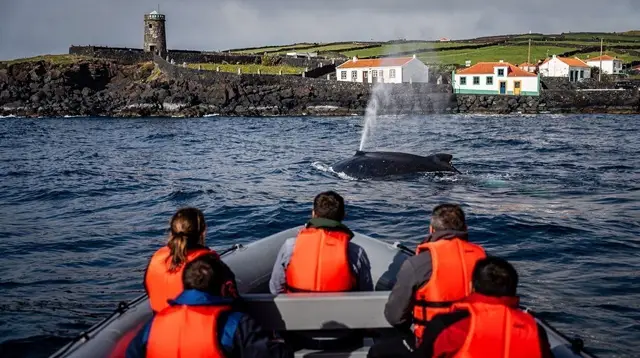
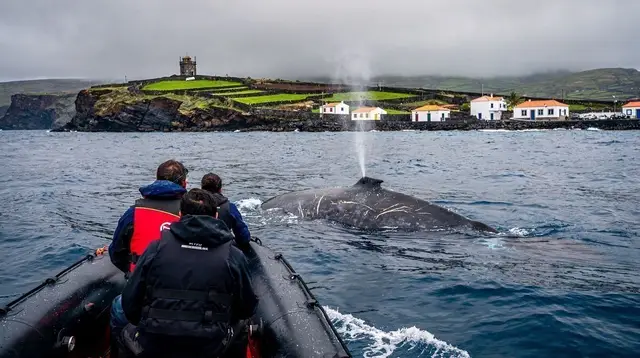
Easily. A hike toward Lagoa do Fogo on São Miguel or a walk along Faial’s trails will put you alongside hedges without any extra planning, and a day on the water for whale watching leaves the afternoon free for a drive.
When should I go if I want to see them at their best?
That’s a question of dates and altitude more than of place, and I’ve written about the timing separately — this is about where to point the car once you’re already here in season.
Seasonal experiences on GetYourGuide
Verified deep-linked GetYourGuide tours. Book through these links and we earn a small commission at no cost to you.
GetYourGuide does not provide a product photo for this activity — the image shows the meeting point, photographed by us.