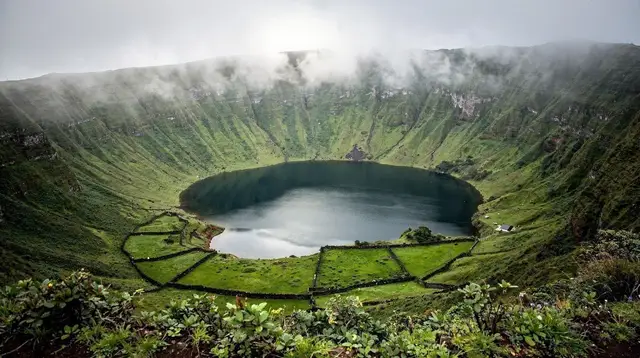
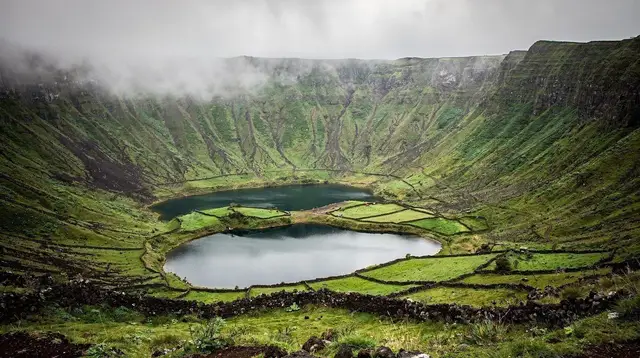
Lagoa sits on the south coast of São Miguel, a working port town of fishermen’s houses, a small black-sand beach and a local viewpoint over the Atlantic — and it has almost nothing to do with the place most visitors are actually picturing when they hear its name. That would be Lagoa do Fogo, the volcanic crater lake set high in the interior of the island, reached by an entirely different road and looking nothing like a seaside town.
The two share a name because “lagoa” is simply the Portuguese word for lagoon or lake, and the island has more than one. This page is about the town, not the lake — if you are looking for the crater lake, its viewpoints and its hiking trail, that belongs on a separate page, and the affiliate tours further down this page point there deliberately, not here.
For a reader driving the south coast of São Miguel, the honest question about Lagoa is not “what is there to do” but “does this deserve a stop at all between two more substantial places.” The short answer is: briefly, if it is already on your route. Lagoa is not a headline destination, and it never claims to be one on any serious itinerary of the island. It is a pleasant, unpretentious pause of an hour or two, best understood as a small beat between Ponta Delgada and Vila Franca do Campo, or as a companion stop to the fishing hamlet of Caloura just up the coast.
Where Lagoa Sits on the South Coast
Lagoa is a municipality and a town roughly 12 km east of Ponta Delgada, on the stretch of coastal road that continues toward Vila Franca do Campo, Ribeira Quente and eventually the Furnas valley on the far side of the island. It is one of the closer south-coast towns to the airport and to São Miguel’s capital, which is exactly why it tends to appear on itineraries almost by accident, as a pin passed on the way to somewhere else rather than a planned destination.
The town itself is unremarkable in the way that many working Azorean towns are unremarkable: a parish church, a cluster of cafés and small shops, whitewashed houses with black basalt trim, and streets that slope down toward a small harbor. What sets Lagoa apart from a pure drive-through is a short run of coastal features within a few minutes of the town center — its port, its black-sand beach, and a viewpoint that looks back along the coastline toward Ponta Delgada on a clear day.
Travelers frequently confuse three different “Lagoa” names on this island, and it is worth being explicit about all three so the confusion does not follow you into a GPS search. Lagoa the town, covered here, sits at sea level on the south coast. Lagoa do Fogo, the crater lake, sits well inland at altitude, ringed by scrubland and reached via a mountain road with its own parking and viewpoints. And the parish of Lagoa also gives its name to the broader municipality that technically includes nearby villages — a detail relevant to local administration, not to a two-hour visit, and not something a visitor needs to track.
The Port, the Beach and the Viewpoint
Lagoa’s small fishing port is the most photogenic corner of the town: working boats, nets drying in the sun, and the kind of unstaged, everyday activity that contrasts with the more polished harbor at Ponta Delgada. It rewards a slow fifteen- or twenty-minute walk rather than a planned activity, and it is a reasonable stop for anyone building a photography-focused route along the south coast — quieter and less crowded than the marina at Ponta Delgada or the harbor views at Vila Franca do Campo.
A short walk or drive from the center brings you to Lagoa’s black-sand beach, a modest stretch typical of São Miguel’s volcanic shoreline. It has none of the scale of the island’s better-known coastal spots, and it functions mainly as a local beach for residents of the town rather than a tourist draw in its own right — expect a quiet visit outside of peak Azorean summer weekends, and a handful of families and locals rather than crowds. It is not the beach to plan a full Azores itinerary around, but for someone already stopping in Lagoa, it is worth the extra ten minutes on foot.
The town’s local viewpoint, set slightly above the coast, gives an open view back along the shoreline in the direction of Ponta Delgada, and out over the Atlantic on a clear day. Like most miradouros on São Miguel, its value depends entirely on the weather: the island’s fast-changing cloud and fog mean the same viewpoint can be spectacular at 10am and closed in by mist an hour later, so treat any promise of “the view” as conditional rather than guaranteed.
Is Lagoa Worth a Stop? A Practical Comparison
The table below is meant to answer the question most readers actually have: given a limited amount of time on São Miguel’s south coast, where does Lagoa rank against its immediate neighbors.
| Stop | What it offers | Time needed | Worth a dedicated trip? |
|---|---|---|---|
| Lagoa (this page) | Working port, black-sand beach, local viewpoint | 1–3 hours | No — worth a stop if already on your route |
| Caloura | Small fishing village, swimming area, seaside restaurants | 1–2 hours | Only as a coastal detour, similar priority to Lagoa |
| Vila Franca do Campo | Town center, islet viewpoint, boat trips to the islet | Half a day | Yes, for most itineraries |
| Ponta Delgada | Capital, historic center, marina, main airport gateway | Half a day or more | Yes, almost always |
| Lagoa do Fogo | Crater lake, viewpoints, hiking trail | Half a day | Yes, for hikers and photographers, but it is inland and separate from this page |
Read plainly: Lagoa the town is the lowest-priority stop on this list. That is not a criticism so much as a calibration — on an island with a genuinely dense concentration of highlights, a small working port town was never going to compete with a UNESCO-adjacent crater or a capital city’s historic core. Its case for inclusion rests entirely on proximity: if your route already runs past it, the marginal cost of stopping is low and the reward, while modest, is real.
Getting There and Getting Around
Lagoa sits directly on the main coastal road connecting Ponta Delgada to Vila Franca do Campo and onward toward Furnas, which means almost nobody needs to make a special trip to reach it — you simply pass through, or choose to pull off. From Ponta Delgada, the drive is about 15 minutes; from Vila Franca do Campo, closer to 10.
As with most of São Miguel outside the capital, a rental car is the practical way to visit. Public transport along the south coast exists but runs on a limited, infrequent schedule aimed more at residents commuting to Ponta Delgada than at visitors hopping between small towns for an afternoon. If you are still deciding how to move around the island, the general guidance on car rental in the Azores and driving in the Azores applies here without any local exception — narrow roads, occasional fog on higher stretches nearby, and the usual advice to book a car well ahead in peak season.
Parking in Lagoa itself is straightforward and free in most of the town center and near the port, in contrast to the tighter, sometimes paid parking situation in central Ponta Delgada.
A Realistic South Coast Route
For a reader planning a single day or half-day along São Miguel’s south coast, Lagoa works best folded into a longer loop rather than visited alone. A common and sensible sequence starts in Ponta Delgada, runs the short distance to Caloura for its fishing-village atmosphere and a swim if the weather allows, continues to Lagoa for the port and viewpoint, and finishes in Vila Franca do Campo for lunch and, tide and weather permitting, a boat out to the islet. Travelers with more time sometimes extend the same day toward Ribeira Quente and the Furnas valley, though that turns a half-day loop into a full one.
This kind of flexible day suits a rental car far better than a fixed group tour, since none of these towns individually justifies a booked excursion — they are stops you assemble yourself. For structured itinerary ideas that cover this stretch of the island in more depth, see São Miguel in 3 days, which sequences the south coast alongside the island’s larger highlights.
If You’re Continuing to Lagoa do Fogo
Because the name overlap causes so much confusion, it is worth being direct about where the two places diverge for anyone planning to see both in one trip. Lagoa the coastal town, described above, requires no booking, no hike and no altitude — you park, walk the port and beach, and move on. Lagoa do Fogo, the crater lake, is a separate stop entirely, reached by its own inland road, and it is where most of São Miguel’s bookable tour activity around this name is actually concentrated.
If your route continues inland afterward, a half-day option such as the half-day Lagoa do Fogo excursion covers the crater lake’s main viewpoints without requiring you to plan the drive yourself. Travelers who want to combine the lake with São Miguel’s other well-known crater, Sete Cidades, in a single day can look at a full-day tour pairing Sete Cidades and Lagoa do Fogo.
For those who prefer walking the crater rim rather than viewing it from a car park, a guided Lagoa do Fogo hiking tour is the more active alternative — none of these tours touch the coastal town of Lagoa covered on this page, so treat them as a separate leg of the trip, not an extension of a stop here.
For general orientation on which parts of São Miguel and the wider archipelago deserve your limited time, which Azores island to visit and day trips from Ponta Delgada give a broader frame than this single town can. Photographers weighing whether Lagoa’s port is worth a stop against the island’s more dramatic viewpoints may find Azores photography spots useful for prioritizing. And if you want to sanity-check your overall plan against errors other visitors have made — including this exact name confusion — common mistakes in the Azores covers it alongside other first-timer pitfalls.
Practical Notes for a Short Visit
A stop in Lagoa needs almost no planning, which is part of its appeal for a route that is otherwise tightly scheduled. There is no entrance fee, no reservation and no seasonal closure to work around at the port, beach or viewpoint — the only real variable is the weather, which on São Miguel can shift within the same visit. If the coastal fog rolls in while you are at the viewpoint, a short wait or a return later in the day is often enough to see it clear again, consistent with the island-wide pattern of fast-changing conditions rather than anything specific to Lagoa.
Facilities are basic: a few cafés and small restaurants in the town center, public parking near the port, and no organized visitor infrastructure such as a tourist office or paid attractions. That suits the kind of traveler this page is written for — someone passing through on a self-driven south coast route, not someone building a day specifically around this town.
Frequently Asked Questions About Visiting Lagoa on São Miguel
Is Lagoa the same place as Lagoa do Fogo?
No. Lagoa is a coastal town on São Miguel’s south shore, with a port, a black-sand beach and a viewpoint at sea level. Lagoa do Fogo is a volcanic crater lake several kilometers inland, at altitude, reached by a separate road. They share a name because “lagoa” simply means “lagoon” or “lake” in Portuguese, but they are unrelated stops.
How far is Lagoa from Ponta Delgada?
About 12 km, roughly 15 minutes by car along the south coast road. It sits between Ponta Delgada and Vila Franca do Campo, and just past Caloura if you are coming from the Ponta Delgada side.
Is there a beach in Lagoa, and is the sand black?
Yes, Lagoa has a small black-sand beach near its port, typical of São Miguel’s volcanic coastline. It is modest in size and used mainly by locals rather than set up as a tourist beach resort.
How long should I plan for a stop in Lagoa?
One to three hours covers the port, the beach and the local viewpoint at an unhurried pace, including a coffee stop. It is not a destination that needs a half or full day on its own.
Is Lagoa worth visiting if I only have a few days on São Miguel?
It is an optional, low-priority stop rather than a must-see. If your route already runs along the south coast between Ponta Delgada and Vila Franca do Campo or Furnas, a short detour costs little; it would not be worth a dedicated trip on a tight itinerary.
Can I combine Lagoa with Caloura or Vila Franca do Campo?
Yes, and this is the most sensible way to see it. Caloura’s fishing harbor and Vila Franca do Campo’s town center and islet viewpoint sit within about ten to fifteen minutes of Lagoa in either direction, so all three fit naturally into one south coast morning or afternoon.
Is there anywhere to eat in Lagoa?
Lagoa has a handful of local cafés and simple restaurants around its center and port, mostly serving Azorean home cooking and fresh fish, but nothing on the scale of Ponta Delgada or Vila Franca do Campo. It suits a coffee or a quick lunch, not a destination meal.
Do I need a car to visit Lagoa?
Effectively yes. Public transport along the south coast is limited and infrequent, and a rental car is the practical way to link Lagoa with nearby towns and the rest of São Miguel’s south coast in a single outing.