What São Jorge's Cheese Taught Me About the Island
A wheel of cheese that smells like weather
I did not expect a cheese to explain an island to me, but that is roughly what happened on São Jorge. I had come for the fajãs, those strange flat shelves of land squeezed between cliff and ocean, and I left thinking mostly about a cheese I could not stop picking at on the ferry back to Faial.
It started, unglamorously, at a roadside counter outside Velas, where a woman was selling wedges wrapped in wax paper from a cooler in the back of her car. I bought a small piece out of politeness more than appetite, expecting something like the mild, rubbery cheeses I had eaten on the mainland. What I got instead had a bite to it, an almost meaty sharpness, with a texture somewhere between a hard cheddar and something crumblier, older, more mineral. I remember standing by the car eating it slowly, in no hurry, because it did not feel like a snack. It felt like something that wanted attention.
Following the trail to a queijaria
A few days later, driving the loop road toward Calheta, I stopped at a small queijaria that a guesthouse owner had scribbled on a napkin for me the night before, half a name and a rough direction rather than an address. It was a modest, functional building, more workshop than shop, with the low hum of refrigeration behind a half-open door and the particular, slightly sour smell of milk in the process of becoming something else.
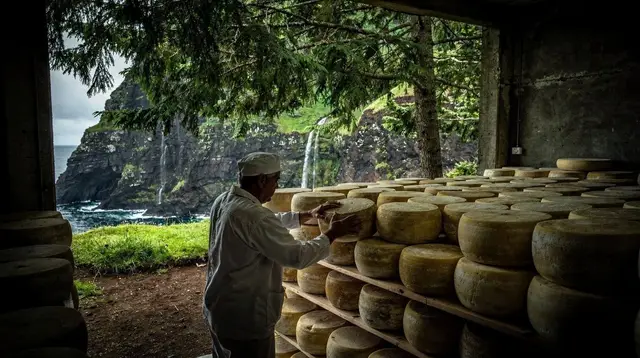
The man who showed me around, whose family had been making cheese there for three generations, walked me past the vats and the aging room with the unhurried patience of someone who has explained this a thousand times and still finds it worth explaining. Wheels of different ages sat stacked on wooden shelves, each with a handwritten date, and I understood for the first time that what I had eaten on the roadside was not one cheese but a family of them, separated only by how long they had been left alone in that cool, dim room.
He cut me a sliver from a wheel that had been aging for something over seven months, then another from one barely three months old, and set them side by side on his palm. The young one was pale, soft at the edges, almost sweet. The older one was darker, drier, and hit the back of my tongue with a pepper-like sting that lingered long after I had swallowed. It was the same milk, the same hands, the same room, and yet they tasted like two entirely different foods. That gap, more than anything else, is what I think about now when I picture São Jorge.
The pastures that make the argument for you
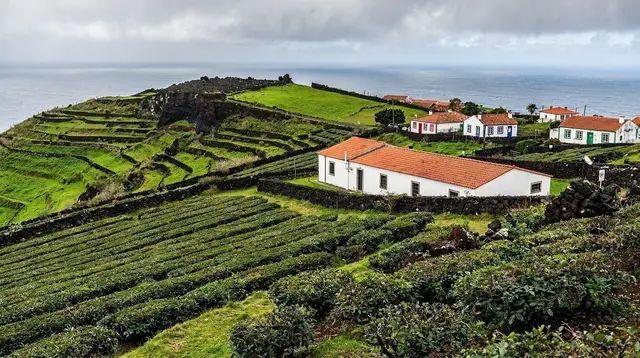
What struck me almost as much as the cheese itself was how little separation there was, on this island, between the pasture and the product. Driving between villages, the fields run right up to the cliff edges, an unbroken green that does not pause for the roads cut through it, and the cattle graze there year-round because the island rarely gets cold enough or dry enough to force them indoors. The queijeiro told me, matter-of-factly, that the volcanic soil and the constant damp are the reason the milk tastes the way it does, and that no one on São Jorge would think to argue the point, because it is simply understood as fact rather than marketing.
It is easy, reading about places, to treat “terroir” as a word that belongs to wine, but standing in that pasture-cheese-pasture loop on São Jorge made it feel less abstract. The grass is different because the rock underneath it is different, the milk is different because the grass is different, and the cheese carries all of that forward, aging into something sharper the longer it sits. It is one of the few times a Protected Designation of Origin has felt, to me, less like a legal label and more like an honest description of cause and effect.
An economy built on a wheel of cheese
Later that evening, over dinner in Velas, the conversation drifted, as it tends to on this island, toward how quiet São Jorge feels compared with São Miguel or Terceira, and how much of daily life here still runs on cattle and cheese rather than on tourism.
My host mentioned, almost in passing, that cheese-making and dairy farming were still among the main sources of income for the island’s families, a fact that had not been obvious to me from the road, where the villages look sleepy and the pastures look purely scenic. It reframed the whole landscape for me: those fences and grazing herds were not backdrop, they were livelihood, running in parallel with the tourism that has grown around hiking the fajãs and exploring the coastline.
I left the island a couple of days later on the short ferry hop that connects São Jorge, Pico, and Faial, and I noticed, boarding, how many of my fellow passengers were carrying the same wax-paper-wrapped wedges I had bought outside Velas, tucked into daypacks like souvenirs too good to check as luggage. It made sense. If you have spent even a few days on São Jorge, watching the cattle on the cliffs and the wheels stacking up in a cool back room, the cheese stops being a thing you buy and starts being a thing you understand.
If a short visit to the island fits into a wider Azores itinerary, I would pair it, as I did, with a slower wine detour on Pico just across the water, since the two islands share that same volcanic stubbornness, one expressed through vines wedged into lava, the other through cattle on green cliffs.
For travelers building out the rest of an Azores trip from São Miguel, a guided food walk through Ponta Delgada’s markets is a useful counterpoint, showing how differently food culture plays out on the archipelago’s largest island. And for a first, easy orientation to São Jorge’s landscape before the cheese detour, a half-day panoramic tour around the island is a gentler introduction than renting a car cold.
Questions readers ask me about São Jorge’s cheese culture
Why is São Jorge’s cheese considered special among Azorean cheeses?
It carries a Protected Designation of Origin tied to the island’s volcanic pastures, and its flavor sharpens dramatically with age, from mild at a few months to peppery and crumbly past seven. It is also one of the island’s main sources of income, alongside cattle farming.
What does Protected Designation of Origin actually mean for this cheese?
It means the milk, the recipe, and the aging must happen on São Jorge itself, under rules that tie the product legally to the island’s specific pastures and traditions, the way Champagne or Parmigiano Reggiano are tied to their regions.
Does the cheese taste different depending on how long it has aged?
Very much so. A young wheel is soft and mild, closer to a table cheese, while an aged one turns hard, granular, and sharply peppery, closer in character to an old, salty mountain cheese than to anything mild.
Is cheese-making still a family activity on São Jorge?
In many parishes, yes. Small queijarias run by families who also keep the cattle are common, alongside larger cooperatives, and the two scales coexist rather than one replacing the other.
Why does the article keep mentioning cattle and pastures?
Because the cheese cannot be separated from the land it comes from: the volcanic soil, the year-round green pasture, and the herds are the first link in a chain that ends in the wheel of cheese, and the island’s economy leans on both ends of that chain.
Is this article a practical buying guide?
No. It is a personal, narrative account of one visit and one tasting; for where to buy the cheese, how to taste it properly, and current prices, the dedicated cheese guide covers that ground, alongside the broader Azorean food guide for the wider culinary picture.
tours.food-gastronomy
Verified deep-linked GetYourGuide tours. Book through these links and we earn a small commission at no cost to you.
GetYourGuide does not provide a product photo for this activity — the image shows the meeting point, photographed by us.