Is the Azores Expensive? What I Actually Spent
I’ll say the honest thing up front: when I was still deciding whether to book the Azores or put that money into a week in Madeira instead, every article I read gave me a daily number — so many euros for a meal, so many for a room — and none of it matched what I actually spent. Not because the numbers were wrong, but because I was still thinking of the Azores as one place, when it’s nine islands that behave more like nine separate small trips stitched together.
That’s the piece I wish someone had told me before I compared prices and clicked “book.”
Comparing to Madeira and mainland Portugal — the wrong question, sort of
If you’re doing what I did — sitting with three browser tabs open, one for the Azores, one for Madeira, one for a generic Portugal itinerary — the prices on paper look close. All three are Portuguese, all three are priced in euros, and a plate of fresh fish or a simple room for the night costs about what it costs anywhere else in the country. On that level, the Azores are not the expensive outlier people sometimes make them out to be.
Where the comparison breaks down is logistics. Madeira is one island. You land, you rent a car once, and you drive it for the whole trip. Mainland Portugal has a real road and rail network connecting everything. The Azores have neither of those luxuries. Each island is its own small rental-car market, and getting from one to the next means a flight or a ferry — never a bridge, never a highway. That’s the cost mainland Portugal and Madeira simply don’t add to your total, and it’s the reason a like-for-like “Azores vs Madeira” price comparison needs a footnote before you trust it. If you want the fuller version of that comparison, I’ve laid it out separately in my Azores vs Madeira comparison.
The car rental line item nobody warns you about
I’ll be blunt about the trap I nearly fell into: pricing a week in the Azores using a single week-long car rental, the way I would for Madeira. That number is only true if you stay on one island the whole time.
The moment your itinerary adds a second island — say São Miguel, then Pico — you’re not extending one rental. You’re closing it out, flying or taking the ferry, and opening a brand new rental on arrival, with its own deposit, its own fuel policy, its own daily rate. Do that across three islands and you’ve effectively paid for three separate short-term rentals instead of one longer, cheaper one. I go deeper on how to actually book this without duplicating fees in my car rental guide, and on what driving here is actually like — narrow lanes, fog on the crater roads, the odd cow standing in your lane — in my guide to driving in the Azores.
A car here isn’t optional the way it can be in a big mainland city. Between-village transport is thin, and outside the main towns you need your own wheels to reach anywhere that matters — that’s true on every island, it just gets paid for once per island rather than once per trip.
Flights and ferries: the real archipelago tax
This is the cost category that doesn’t exist at all in a Madeira or mainland Portugal budget, and it’s the one that quietly decides whether your Azores trip feels reasonably priced or surprisingly expensive.
SATA Air Açores runs the scheduled inter-island flights, and Azores Airlines handles the longer routes to the mainland. Atlânticoline runs the ferries. The good news, and the one genuinely budget-friendly fact in this whole equation, is the “Triangle” — Pico, Faial and São Jorge — which is connected by ferry year-round, several times a day, at a price that won’t wreck a trip. If your plan is a multi-island route, building it around that triangle (see the Pico–Faial day trip by ferry and my inter-island ferries guide) is the cheapest way to island-hop.
Step outside the Triangle, though, and the maths changes. The wider central-group ferry network only runs June to September. Reaching the eastern or western groups mostly means flying, and those flights — especially to Flores and Corvo — cost more and run less often than a first-timer expects. I cover the mechanics, and where the fares tend to land, in my SATA inter-island flights guide and the inter-island ferries guide.
So the honest budgeting question isn’t “how much is the Azores,” it’s “how many times am I planning to leave an island.” Every departure is a line item that mainland Portugal and Madeira simply never charge you.
What meals actually cost me
Food is the one category where the Azores genuinely don’t punish you. A casual lunch — fish, a simple grilled dish, a bowl of soup — runs close to what you’d pay in a mid-sized mainland Portuguese town, sometimes less outside Ponta Delgada. The one meal worth planning and pricing ahead of time is cozido das Furnas, the meat-and-vegetable stew slow-cooked for six or seven hours in the volcanic ground near the Furnas lagoon.
It’s not expensive by the plate, but it is something you book into a restaurant 24 to 48 hours ahead (longer in July and August), because the pots go into the ground before dawn and come up mid-morning — you can’t decide on a whim at 1pm that you’d like some. I’ve written the details up in my cozido das Furnas guide, and the wider food scene, including São Jorge’s cheese and the Gorreana tea plantation, in my Azorean food guide.
Thermal bathing is the other small, specific cost worth knowing in advance rather than guessing at: Terra Nostra Park’s hot pool and Furnas’ Poça da Dona Beija both charge a modest entry fee, with the Poça charging more after 6pm than before 5:30pm — small print that’s easy to miss until you’re standing at the gate.
What I’d actually tell a first-timer
If price is the single deciding factor between the Azores and somewhere else, pick one island — São Miguel is the obvious, well-connected choice — and price that trip the way you would a Madeira trip: one flight in, one rental car, one hotel base or a couple of moves within the same island. Priced that way, the Azores are not more expensive than mainland Portugal, and not dramatically different from Madeira either.
What I’d stop you from doing is pricing a single-island week and then mentally scaling it up to “and I’ll just add Pico and Faial too” without recalculating. That second and third island each bring their own car rental and their own flight or ferry fare, and that’s the real reason a nine-island archipelago can end up costing more than a nine-mile-long island — not the food, not the entry tickets, but the distance between the parts.
For a route that actually accounts for that honestly, I’d start with how many days in the Azores and which Azores island to visit, then look at a built itinerary like a 10-day, three-island route or the island-hopping guide before you commit to how many islands you’re really doing.
If you decide the multi-island version is worth it — and for me, seeing Pico’s cone from a whale-watching boat off a São Miguel whale and dolphin watching trip made it worth every extra ferry fare — budget for the flights and the second rental car from day one, rather than discovering them after you’ve already booked flights to Ponta Delgada.
A morning on the crater trail with a guided Lagoa do Fogo hike or a day out on a 4x4 tour through Nordeste costs about what you’d expect for a guided activity anywhere in Portugal — it’s the getting-there-and-back-again between islands that changes the total, not the things you actually do once you’ve landed.
For the structured version of daily numbers I’ve deliberately left out here, see the Azores daily budget breakdown; for how to spend less on where you sleep, where to stay in the Azores; and for stretching a tight budget with things that cost nothing at all, free things to do in the Azores.
Frequently asked questions about the cost of visiting the Azores
Are the Azores cheaper than Madeira?
They’re broadly similar for a single-island trip, since both are Portuguese, euro-priced destinations. The Azores get more expensive than Madeira as soon as you add a second or third island, because Madeira is one island you can drive end to end, while the Azores force you to fly or ferry between separate rental-car zones.
Are the Azores cheaper than mainland Portugal?
Day-to-day costs — coffee, a plate of fish, a room for the night — sit close to mainland Portugal. What mainland Portugal doesn’t have is the extra layer of inter-island flights, ferries and repeated car rentals that a multi-island Azores trip adds on top.
Is renting a car in the Azores expensive?
A single rental on one island is reasonably priced. The cost multiplies on a multi-island itinerary because each island has its own rental fleet — you drop the car before flying or taking the ferry, then pick up a new one on arrival, and pay a new set of fees each time.
How much does it cost to fly or ferry between the Azores islands?
Inter-island flights with SATA Air Açores and ferries with Atlânticoline are not free extras — they’re a recurring line item on any multi-island route. The Pico–Faial–São Jorge ferry triangle runs year-round and is the most affordable and reliable inter-island link; flights to the outer groups tend to cost more and thin out outside summer.
Can I do the Azores on a tight budget?
Yes, but the budget version of the Azores is a one-island trip, not a nine-island one. Sticking to a single island lets you skip the extra car rental, flight or ferry costs that come with island hopping.
Do the Açores cost more than the Canary Islands?
It’s a different kind of spending, not simply more or less. The Canaries have cheaper, more frequent inter-island transport and a longer dry season that stretches a budget further; the Azores charge more for the logistics of getting between islands, offset by the fact many of the best things to do — trails, viewpoints, natural pools — cost nothing.
What’s the single biggest expense people underestimate in the Azores?
Treating the archipelago as one island. A week entirely on São Miguel is genuinely affordable. The same week split across São Miguel, Pico and Faial adds a second car rental, a flight or ferry, and often a pricier room near a second airport — costs a first-timer comparing destinations online rarely sees coming.
Trip-planning essentials on GetYourGuide
Verified deep-linked GetYourGuide tours. Book through these links and we earn a small commission at no cost to you.
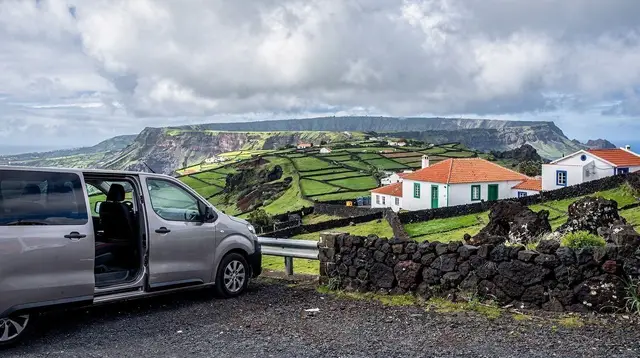
GetYourGuide does not provide a product photo for this activity — the image shows the meeting point, photographed by us.